
How to Soften a Bright Room Without Making It Dark
A bright room can feel harsh when light hits every surface at once. Learn how to soften a sunny room through filtered light, matte surfaces, texture, and warmer contrast, without making it dark.
GUIDESLIGHT & COMFORT


Some rooms are bright in the wrong way. The light is everywhere at once: bouncing off pale walls, hard floors, glossy surfaces, glass, and white paint.
The room looks clean in photographs, but in real life it feels exposed, sharp, and difficult to settle in.
The instinct is to add curtains or repaint the walls. Both can help, but neither solves the real problem if the light is still entering flat and reflecting back from every surface.
A bright room does not need to become darker. It needs softer light, calmer surfaces, and one place where the eye can rest.
Glare vs. Brightness
A bright room and a harsh room are not the same thing. Brightness is the total amount of light in a space. It is not a problem.
Glare is what happens when light hits a surface with nothing to absorb or break it and reflects straight back into the room.
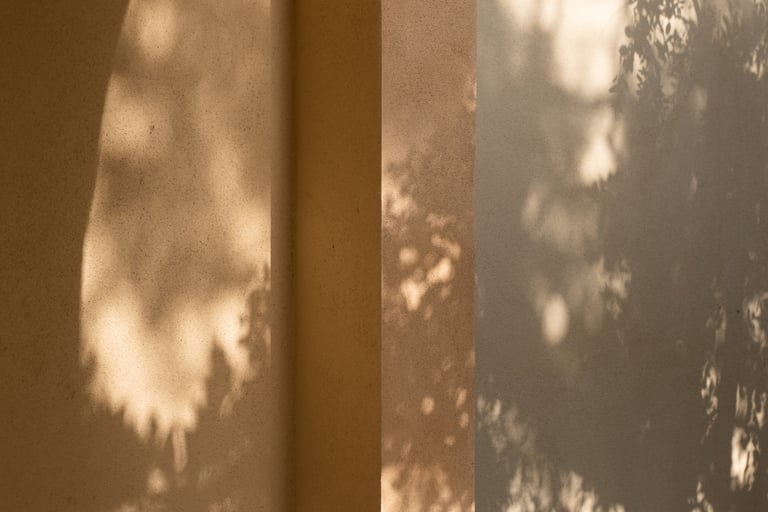
A room can be bright and calm at the same time. Southern light filtered through linen into a room with plaster walls and a stone floor can still be bright, but it no longer feels aggressive. The same light entering a room with smooth white-painted walls, a polished floor, and large unshaded windows is not.
The difference is not the quantity of light. It is what the light is doing when it arrives.
Filter the Window First
Before changing wall colour, floor material, or furniture, look at the window. A fully exposed window — no depth to the reveal, no internal shutter, no fabric — delivers light in a single flat sheet. There is no gradation. The room is fully lit or fully dark.
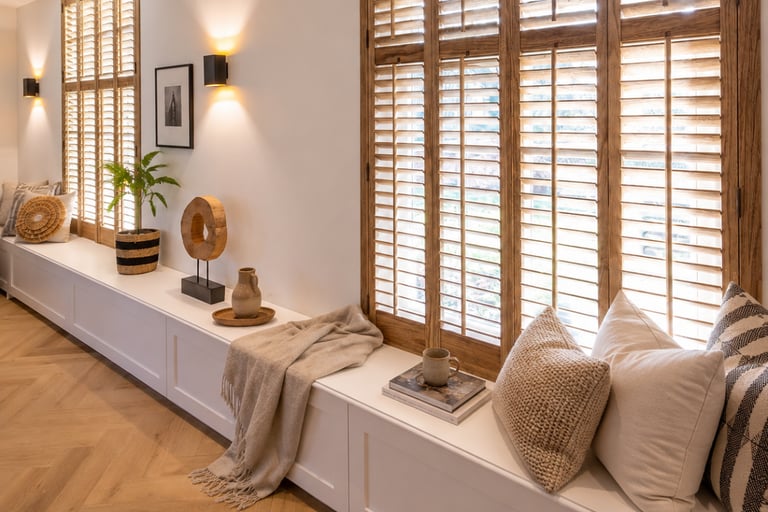
Internal shutters are one of the most effective indoor interventions. Angled at 45 degrees, they direct light toward the ceiling rather than straight into the room. The room stays bright, but the light has somewhere to travel.
Linen curtains or woven blinds soften incoming light without blocking it. The denser the weave, the more filtering without darkness.
If there is an outdoor terrace or balcony, external shade — a vine trained along a pergola, a canvas awning, a deep overhang — is more effective than anything inside. It stops the light before it enters.
START WITH THE LIGHT
Before changing curtains, paint, or furniture, read the light in your own home first.
The free Light Audit helps you see where a room feels too flat, too harsh, or too exposed, and what to address before buying anything.
One Shaded Side
A Mediterranean room is never equally lit. There is one side where light enters — a south or west-facing window, strong and direct. And there is another side that remains in relative shade — a corner, a wall, a zone where the eye can rest.
This asymmetry is not an accident. It is the structure of the room. In a room where every surface receives the same amount of light, the eye has nothing to anchor to. The space feels exposed rather than inhabited.
Creating one shaded side does not mean blocking light. It means using furniture, position, or partial window coverage to ensure one corner stays quieter than the rest. A sofa placed away from the direct line of the window. A bookcase that catches the light on its spine rather than reflecting it back. A floor lamp in a shaded corner, switched on even during the day, can create a second zone with a different quality of light.
This same balance between light, shade, and furniture placement is central to The French Mediterranean Living Room.
Matte Surfaces First
Once the window is addressed, look at where light lands when it enters. The surfaces that receive the first direct light — the wall opposite the main window, the floor in front of it — are the ones that control what happens next.
A pale, smooth, slightly glossy wall bounces light back across the room. A limewash or mineral paint wall on the same surface absorbs it. The room stays bright, but the light has somewhere to land.
The same principle applies to the floor. Stone, terracotta, or matte-finish wood interrupt the bounce. A polished floor or glossy tile amplifies it. The same is true of glass tables, glossy cabinet fronts, polished metal, and shiny tiles. In a room with strong sun, these surfaces do not disappear. They throw the light back.
For material choices in the same room, read Living Room Materials and Finishes.
The rule is simple: matte surfaces in the path of the strongest light, always before pattern or colour.
Texture Before Pattern
Texture and pattern are often treated as interchangeable. They are not. Texture interrupts light at the surface level — a rough plaster wall, a linen weave, raw stone, a woven jute rug. These materials catch and hold light rather than reflecting it back. They make the room feel softer without changing its brightness.
Pattern adds visual information to a surface. It can make a room feel busier, which reads as energy or noise. But it does not address the reflection problem. A patterned glossy tile reflects just as much as a plain one.
If the room feels harsh, add texture before pattern. A linen curtain before a printed one. A limewash wall before a wallpaper. A natural-fibre rug before a geometric one. The change is quieter. The effect is more lasting.
Lower the Contrast
When light is strong, contrast between surfaces becomes sharper. A room with bright white walls, a pale grey laminate floor, and black window frames may look composed in photographs — but under a south-facing summer sun, the contrast reads as harsh rather than graphic.
Warmer whites — those with yellow or red rather than blue undertones — absorb light rather than intensifying it. Stone tones, pale wood, and warm linen do the same. The goal is not to eliminate contrast. It is to remove contrast that has nothing to warm it.
A white wall above a stone floor in morning light reads as settled. The same white wall above grey laminate in afternoon light reads as clinical. This is why a room can look finished and still feel uncomfortable.
Colour is always the last decision, not the first. The Evening Hour and How Houses Hold It goes deeper on how light and colour shift across the day.
Before Buying Anything
Check the room in this order:
· Where does the light hit first — the floor, the walls, or both?
· Which surfaces are reflecting it back into the room?
· Is the main window filtered or fully exposed?
· Is there one side of the room that stays in relative shade?
· Are the main surfaces making the light feel warmer, or sharper?
START WITH THE LIGHT
Not sure where to start in your own room?
The free Light Audit walks you through each observation in order — where light enters, where it becomes harsh, and what to address before buying anything.
For the full room in context, including furniture placement and material choices, read French Mediterranean Living Room Ideas.
A bright room does not need to become darker. It needs filtered light, matte surfaces, warmer contrast, and one side that rests. That is what turns brightness into atmosphere.
Contact
© 2025. All rights reserved.
An editorial study of French Mediterranean interiors, shaped by observation, lived experience, and a respect for spaces that age gracefully.