
Materials That Repeat — Continuity in a Mediterranean House
When the same material appears across rooms, a house reads as one thing. Repetition, not variety, is what gives a Mediterranean interior its calm.
JOURNAL
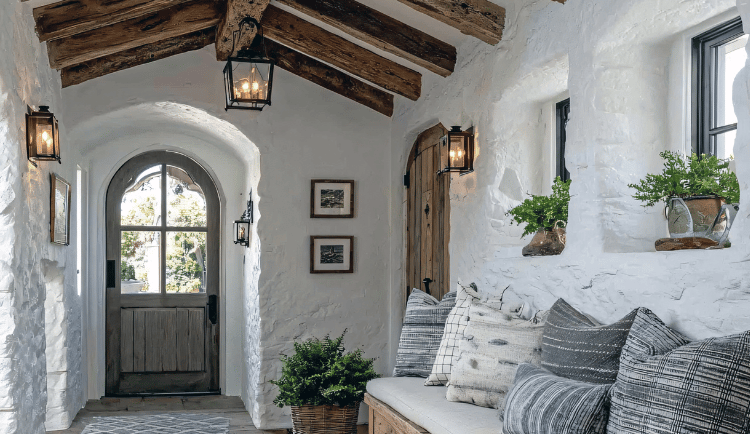
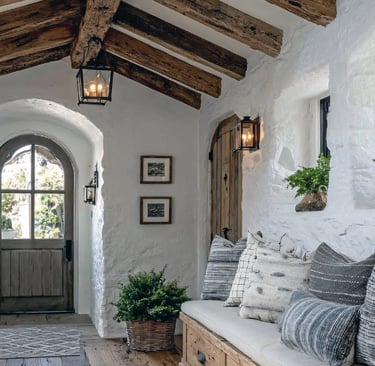
Before materials are noticed
Some houses feel continuous before you notice what they are made of. You move from one room to the next without registering a change underfoot or at hand. The floor does not interrupt you. The walls do not reset. Light behaves consistently as you move through the space, softening or sharpening in familiar ways. The house reads as a single place rather than a sequence of interiors, and that continuity settles the experience before materials are consciously seen.
In environments shaped by strong daylight and long hours of occupation, this continuity matters immediately. Surfaces are touched often. Floors are crossed repeatedly. Walls receive light from different angles across the day. When these elements behave consistently, the house feels stable, grounded, and easy to inhabit. Nothing asks to be reinterpreted as you move.
Repetition as stability
When a material repeats across rooms, the house stops fragmenting. You feel it most clearly underfoot. The same surface carries you from one space to another without interruption. There is no moment where you slow down to register a change, no adjustment in balance or attention. Walls behave the same way from room to room. Their texture, their resistance, the way they hold light remain consistent. The body learns these conditions quickly and stops checking them.
This repetition creates stability not through visual sameness, but through behavioural continuity. You know how the floor will sound when you walk across it. You know how a wall will feel when you lean against it. You know how light will react as it moves across the surface. Nothing surprises you. That absence of surprise allows attention to move elsewhere, toward people, activity, or rest.
In houses shaped for warm climates, this predictability becomes a form of comfort. Materials respond similarly to heat and shade. Surfaces cool at the same pace. The house feels balanced throughout the day, even as light and temperature shift. Repetition allows the building to work with its environment rather than against it.
The same logic governs the surfaces in working rooms, where repetition resolves more decisions than variation does — explored in Materials for Work in the Kitchen.
When materials compete
In houses where materials change from room to room, the experience becomes more fragmented. Each transition asks for attention. The floor shifts underfoot. Walls reset in texture or tone. Light behaves differently with every surface. Movement slows, not intentionally, but because the body is asked to re-adjust repeatedly. The house is read in parts rather than as a whole.
In southern light, this fragmentation is amplified. Daylight is strong, often lateral, and present from early morning to late evening. When surfaces vary too much, light exaggerates the differences instead of softening them. Reflections become uneven. Contrast sharpens. Rooms feel disconnected even when they are physically close. The house begins to feel assembled rather than built.
Material competition also affects thermal comfort. Some surfaces retain heat, others release it quickly. Shade behaves inconsistently. Certain rooms become avoided at particular hours. Instead of supporting daily rhythm, the interior requires constant correction. What was intended as richness becomes restlessness.
Memory, wear, and familiarity
Repetition allows time to act evenly across the house. Wear accumulates gradually and consistently. Edges soften together. Surfaces age at a similar pace. The house develops a shared memory rather than a collection of isolated moments.
In places where floors are walked on with bare feet, where walls are brushed past daily, where doors and shutters are opened and closed constantly, this shared aging matters. Familiarity builds not through decoration, but through contact. The house becomes readable by touch as much as by sight.
When materials repeat, wear does not signal decline. It signals belonging. The marks of use feel legitimate because they appear everywhere, not just in isolated zones. The house absorbs life evenly, without privileging certain rooms over others.
When materials repeat, the house develops a shared memory rather than a collection of isolated moments — one of the conditions described in Why Some Houses Are Easy to Live In.
A house read as one thing
Material repetition allows the house to be understood as a whole. Rooms remain distinct in their use, but they belong to the same structure. Transitions are felt through proportion and light rather than contrast. Movement remains fluid. Orientation is intuitive.
This coherence does not limit expression. It supports it. When materials behave consistently, rooms are free to differ through use, furniture, and occupation rather than surface change. The house gains depth without losing calm.
In climates where light, heat, and daily use are constant forces, repetition is not a stylistic choice. It is a practical one. It allows the building to respond as a single body. Calm emerges not from restraint alone, but from alignment. Materials that repeat give the house a steady ground, one that holds daily life without interruption or explanation.
Contact
© 2025. All rights reserved.
An editorial study of French Mediterranean interiors, shaped by observation, lived experience, and a respect for spaces that age gracefully.