
The Role Of Pause: Why Houses Need Moments Of Nothing
Empty space is not waste. Pauses between rooms regulate orientation, daily life, and light. Why a Mediterranean house benefits from what holds nothing.
JOURNAL
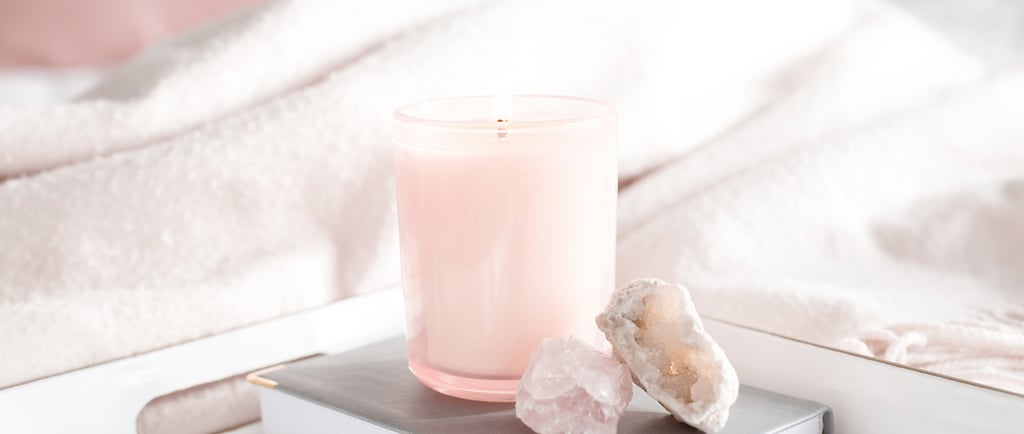
Moments that do not ask for attention
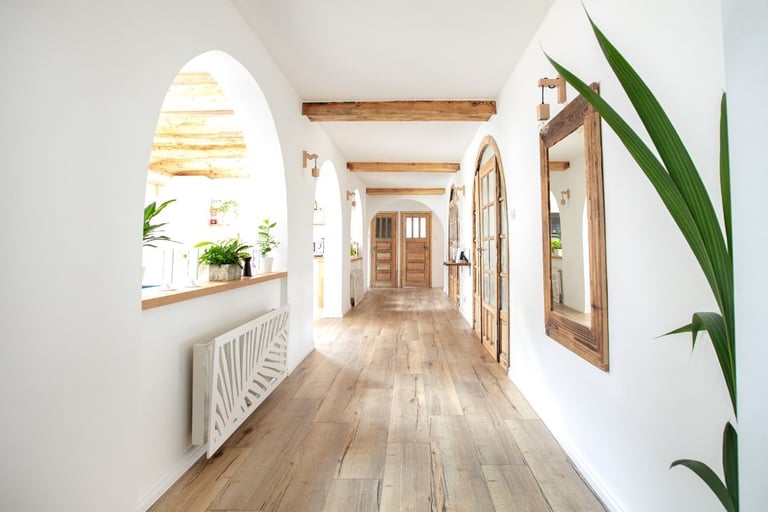
Some of the calmest houses are not the most generous ones. They are not filled with views, gestures, or features. What stays with you instead are the moments where nothing in particular is happening. A short stretch of wall at the end of a corridor. A landing that receives daylight but holds no furniture. A passage that slows you down before the next room opens.
These are not spaces you photograph. They are spaces you pass through. And yet they shape how the house is felt more than most rooms.
What we usually call circulation
In plans, these areas are labelled circulation. In conversations, they are often treated as wasted surface. They exist between rooms and are therefore expected to justify themselves. They are narrowed, furnished, activated. A console to fill the wall. A painting to give meaning. A light fixture to mark intention.
But the more these spaces try to become something, the less they do their actual job.
A pause is not emptiness. It is a moment where the house stops asking for attention.
Sequence, not spectacle
Houses that feel grounded tend to be organised as sequences rather than open displays. You do not see everything at once. Rooms arrive one after the other.
A slight turn before entering the living room. A wall that hides activity until you are close enough to hear it. A change in ceiling height that marks arrival without announcing it.
These small interruptions create rhythm. Compression, then release. Quiet, then presence.
Without them, spaces compete. Every room performs. The eye keeps scanning. The body keeps moving, but without cadence.
Where orientation happens
Pauses are often where you understand where you are.
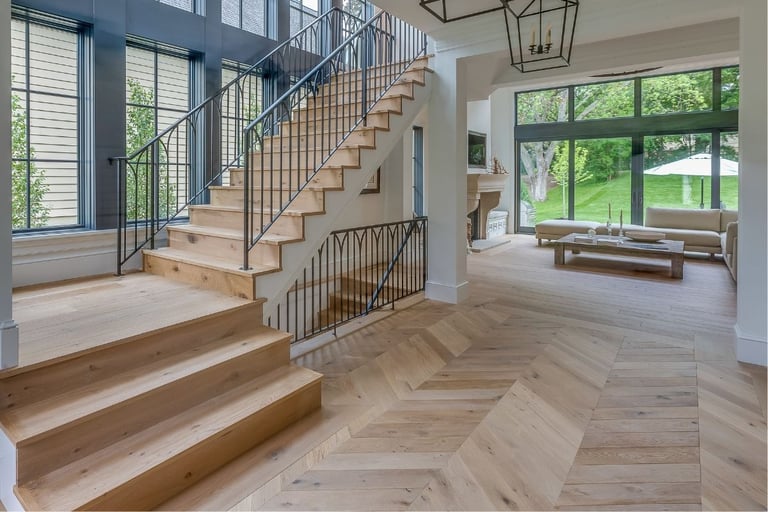
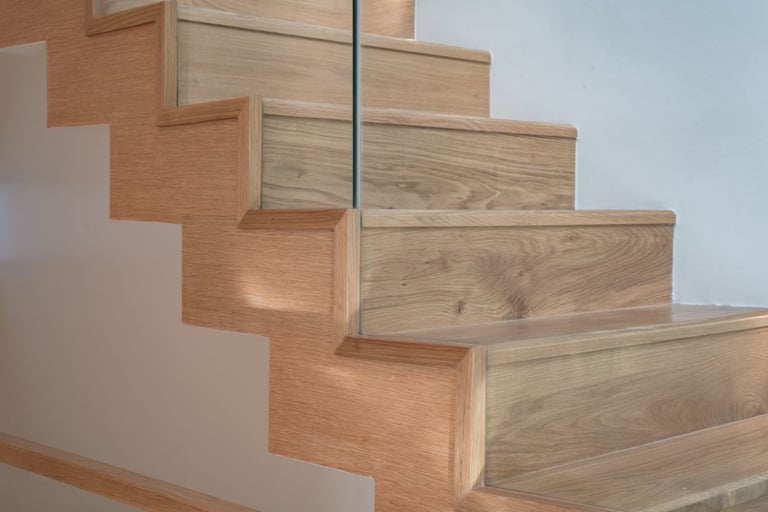
A stair landing that receives light from above. You stop briefly, not because you intend to, but because the space allows it. You know whether you are going up toward bedrooms or down toward shared rooms. No signage, no furniture, no explanation.
In family or holiday houses, these moments matter even more. People arrive at different times of day. Children run ahead. Guests hesitate. The house needs to orient without instructions.
A pause does that quietly.
Light that does not perform
These spaces rarely receive direct, frontal light. Light arrives indirectly, reflected from another room or filtered from above. It is softer, less defined.
This signals that the space is transitional. You are not meant to stay long, but you are allowed to slow down. The eye adjusts. The next room feels calmer because you did not arrive at it abruptly.
Light does not need to perform everywhere. In-between spaces benefit from discretion.
Material continuity and restraint
Pauses work best when materials do not change abruptly. The same floor continues. Walls remain neutral. Doorways are felt through depth rather than contrast.
This is not about minimalism. It is about refusing unnecessary signals.
When materials stay consistent, the body focuses on movement rather than interpretation. You walk, you turn, you arrive. Nothing asks you to decode intention.
Daily life, not concepts
The value of pause becomes most obvious in routine moments.
Moving from bedroom to bathroom in the morning. Coming back from the beach with sand still on your feet. Circulating through the house while others are already active.
If every transition is exposed or over-defined, these moments feel abrupt. A short neutral passage between them introduces calm without adding comfort objects or decoration.
Children instinctively occupy these spaces. They stop on stairs. They sit on landings. They wait in corridors. Not because the spaces were designed for them, but because they are not assigned.
This is not an anecdote. It is a clue.
Why rooms benefit from what happens between them
When transitions are clear, rooms do not need to overstate their role. A bedroom can remain sparse because it is not visible from everywhere else. A living room can feel anchored because it is reached deliberately.
Calm is rarely produced by a single space. It emerges from how spaces relate.
Pauses are where the house stops talking and starts listening. These pauses are not decorative. They are the small thresholds that make movement feel intentional — a logic developed in Thresholds: Where the House Changes Pace.
Houses that try to optimise every square metre tend to feel busy regardless of how few objects are in them.
The pause is not waste — it is what allows the room beside it to feel arrived at rather than continuous. Without these intervals, transitions disappear, sequence collapses, and the house begins to behave as one undifferentiated volume.
The rooms benefit from what happens between them precisely because what happens there is nothing — which is what gives everything else its proper position.
In a house that tries to remove every empty space, the rooms feel busier rather than fuller. Open Plans and the Loss of Sequence describes what happens when even the wall is treated as friction.
Contact
© 2025. All rights reserved.
An editorial study of French Mediterranean interiors, shaped by observation, lived experience, and a respect for spaces that age gracefully.