
Thresholds in a House — Where Pace Changes
Thresholds slow movement, mark transitions, protect rooms. Doors, steps, level changes — small interruptions that hold a Mediterranean house together.
JOURNAL
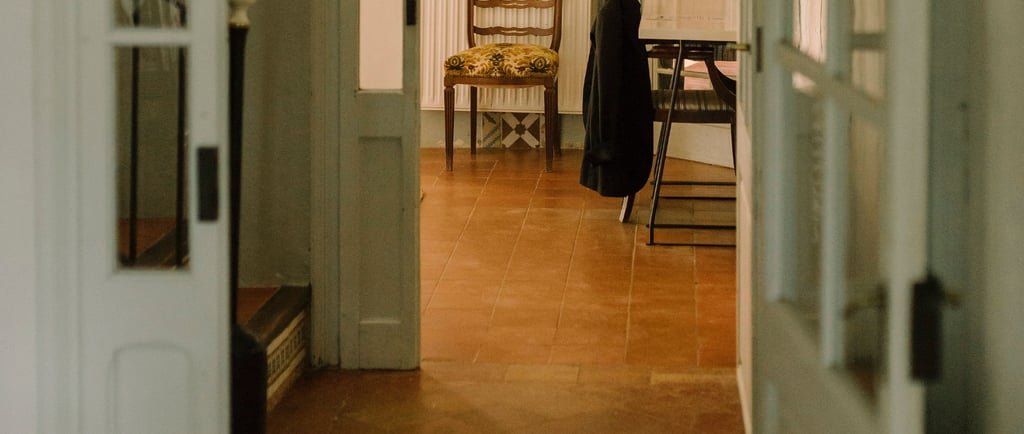
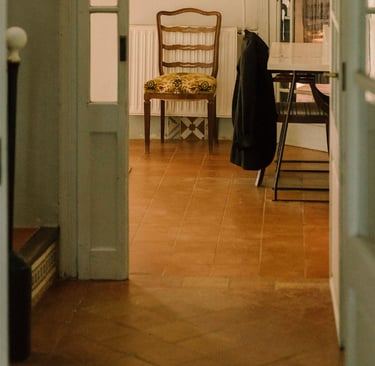
In a French Mediterranean home, comfort is not created all at once.
It unfolds.
The experience of the house is shaped as much by what happens between rooms as by the rooms themselves. Doors, steps, level changes, and pauses quietly organise how the house is lived. These moments of transition are rarely decorative, rarely discussed, and yet essential.
A threshold is not simply a physical boundary. It is a shift in rhythm.
Movement slows here
Mediterranean houses are not designed to be consumed in a single glance. They resist immediacy.
As you move through the house, your pace changes. You pause at a doorway. You adjust your footing on a step. You pass through a shaded passage before reaching a brighter room. These small interruptions regulate movement and attention.
Unlike open-plan interiors that encourage constant visual exposure, Mediterranean homes allow the body to arrive gradually. Each threshold introduces a brief moment of adjustment. This is not inefficiency. It is comfort.
The house acknowledges that living is sequential.
Doors as regulators, not dividers
Doors in Mediterranean homes are not primarily about privacy or separation. They are regulators.
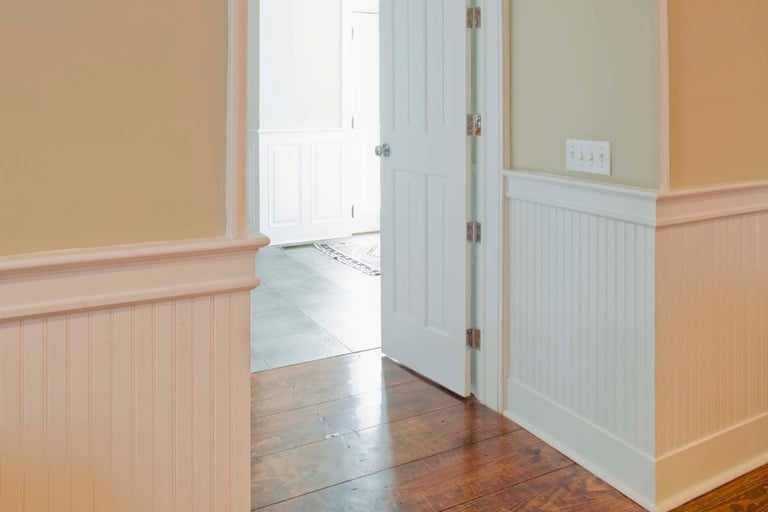
A door controls light, sound, temperature, and atmosphere. Even when left open, its presence frames the transition. The thickness of the wall, the depth of the opening, the way light pools differently on either side all signal that one space is ending and another is beginning.
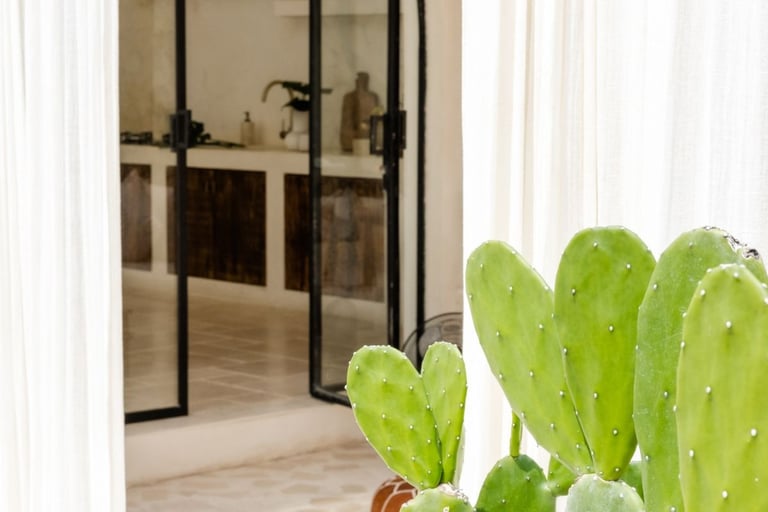
Sliding doors, shutters, and double doors often soften this transition rather than sealing it. The goal is not to close space off completely, but to modulate it.
A threshold does not say “stop.”
It says “change pace.”
Steps and level changes
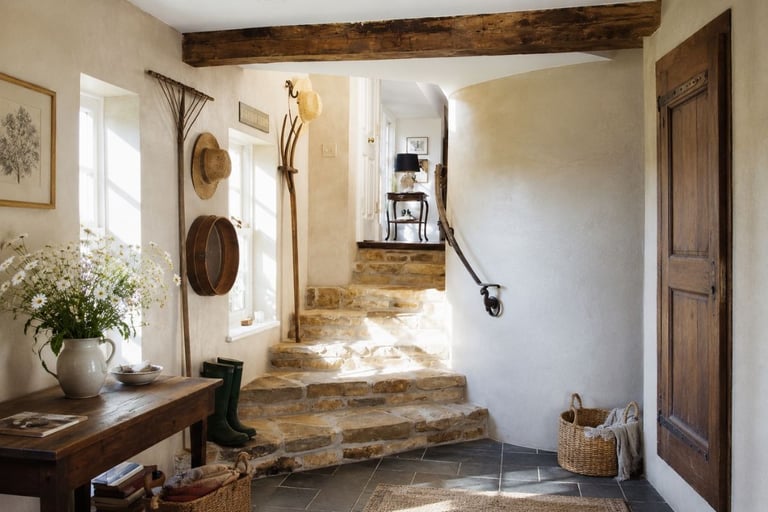
Many Mediterranean houses are not flat. Floors rise and fall subtly. A single step marks the entrance to a living room. A lowered floor signals a place to sit. A raised platform slows movement before a more private area.
These changes in level are rarely dramatic. They are measured, almost modest. Yet they carry weight.
The body feels them immediately. You adjust your stride. Your posture shifts. Without signage or explanation, the house communicates how the space is meant to be used.
This physical awareness grounds the experience of the interior. The house is not an abstract container. It is something you move through with your body.
Corridors as pauses, not leftovers
In many contemporary layouts, corridors are treated as wasted space. Mediterranean houses see them differently.
A corridor is a pause. It is a moment where nothing is demanded of you. Light is often softer here. Decoration is minimal. The purpose is not to impress but to allow transition.
These spaces give the house its rhythm. Without them, rooms collapse into one another. Everything competes for attention at once.
A corridor absorbs excess. It allows rooms to remain calm because they are not forced to perform continuously.
Without thresholds, the house loses the small interruptions that allow it to feel composed. Open Plans and the Loss of Sequence examines what is lost when those interruptions disappear entirely.
From public to private, quietly
Mediterranean homes do not announce their hierarchy. There are no signs declaring which spaces are formal or intimate. The transition is felt instead.
As you move deeper into the house, ceilings may lower slightly. Light becomes more filtered. Openings narrow. Materials soften. The body understands that the space is becoming quieter.
This progression mirrors daily life. Social spaces come first. Withdrawal comes later. The house respects this order without enforcing it.
Privacy is not created by locks or labels, but by sequence.
The outdoor threshold
The boundary between inside and outside is one of the most important transitions in Mediterranean architecture.
Terraces, loggias, covered walkways, and shaded patios are not secondary spaces. They are thresholds in their own right. They allow the body to adapt to changes in temperature, light, and sound.
Moving from interior to exterior is rarely abrupt. There is almost always an intermediate space that belongs to both. This reduces contrast and preserves comfort.
The house does not end at the wall. It dissolves gradually.
A house that moves with you
Over time, these in-between spaces become deeply familiar. You slow instinctively at certain points. You pause where light changes. You linger in places that offer shade or enclosure.
The house teaches you how to live in it, without instruction.
This is one of the defining qualities of French Mediterranean interiors. They do not perform for the visitor. They support the inhabitant.
What a house with thresholds gives you is permission to slow down without leaving. You move through it the way the day moves — in stages, with small interruptions that do not break continuity but mark it.
The house does not insist on speed.
It does not insist on visibility.
It moves with you, holding the pace you set, and the calm that follows is not a quality added to the rooms; it is what the rooms already do when their transitions have been respected.
What a threshold gives is permission to slow down without leaving the room. The same idea — pauses that hold attention rather than demanding it — is developed in The Role of Pause.
Contact
© 2025. All rights reserved.
An editorial study of French Mediterranean interiors, shaped by observation, lived experience, and a respect for spaces that age gracefully.