
Ceiling Height and Proportion in a Mediterranean Room
What sits above eye level decides whether a room feels generous or strained. Scale, sound, light — the space above the sightline shapes what is below.
JOURNAL
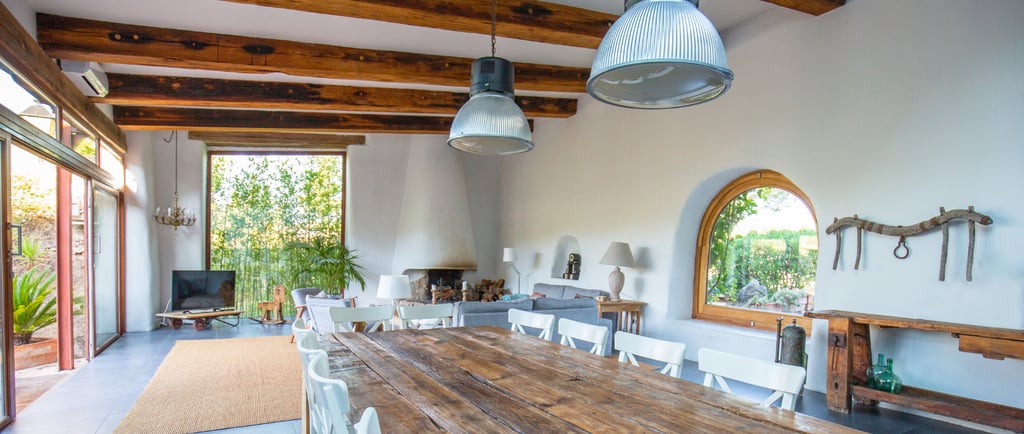

Why ceiling height shapes a room more than its floor plan
A room does not have to be large to feel spacious. In older Mediterranean houses, this is easy to verify. A small salon, narrow in plan, can feel unexpectedly open the moment you step inside. Not because of furniture, not because of colour, not because of arrangement. Because of height.
Floor area tells you how much ground you occupy. Ceiling height determines how that space is held around you.
The body does not experience a room as a plan. It experiences it from a fixed position, moving through air, registering pressure, sound, and light. Vertical space acts on all three at once.
How height settles over time
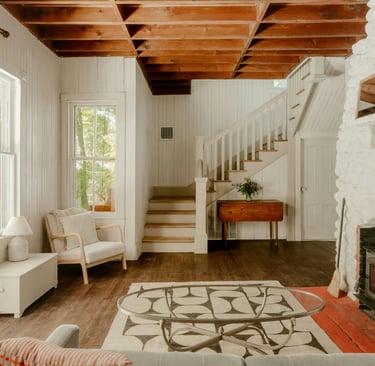
Walk into a room with a ceiling four metres high and you notice it immediately. The volume is obvious. The air feels different.
Then something changes. After a few minutes, the awareness fades. You stop looking up. The room no longer feels tall. It simply feels easy.
Sit down at a table. Speak. Move across the room. Nothing calls attention to itself. The ceiling has receded from perception.
In a lower room, the opposite happens. You may not consciously register the ceiling, but it remains present. It sits in the edge of your awareness. When you stand up, when you stretch, when you cross the room, there is a subtle sense of proximity above you. The space feels contained, even when it is well proportioned.
Height does not make a room impressive. It removes a constraint.
What the body registers
The difference is not visual alone.
In a low room, the body calibrates itself to enclosure. Movements become slightly more contained. Voices stay closer to the speaker. The space encourages focus and inwardness. This is why lower ceilings often feel appropriate in bedrooms or kitchens. The compression supports the function.
In a taller room, the body relaxes its calibration. You do not adjust your movement to the ceiling because it is no longer part of your active awareness. The space feels open without asking you to acknowledge it.
This is not about luxury. It is about proportion in relation to use.
In many Mediterranean houses, this distinction is clear without being stated. The principal room, where people gather, is higher. The bedroom, where the body rests, is lower. Moving between them produces a shift you feel immediately, even if you do not name it.
What height does to sound
The effect of height becomes even clearer when people begin to speak.
In a low-ceilinged room, sound returns quickly. A conversation between two people fills the space immediately. Add more people, and the room becomes dense with sound. This can feel lively, even pleasant, but it has a limit.
In a taller room, sound behaves differently. Voices rise before they return. A conversation stretches upward, and the room absorbs part of it before releasing it back. The result is not echo, but spacing. Multiple voices can exist without colliding.
Sit at a long table with six or eight people. In a low room, you begin to lean in, speak slightly louder, compensate. In a tall room, you remain at ease. The room is doing part of the work.
This is why older dining rooms were often built with height. Not for display, but for use.
Where light settles
Height also determines where light sits in a room.
In a low-ceilinged space, light fills everything quickly. There is little distance for it to travel. The room becomes uniformly bright or uniformly dim.
In a taller room, light begins to separate into zones. The brightest area sits near the windows. Above that, the ceiling can remain slightly in shadow. Below, where the body is, the light is softened, arriving indirectly.
Stand in the doorway in the afternoon and look into the room. You do not see a flat field of brightness. You see layers. The upper wall catching light, the ceiling holding back, the lower space settling into a more stable tone.
This layered light is one of the reasons older rooms remain comfortable across the day, without requiring constant adjustment — a quality also found in houses that are easy to inhabit, as explored in Why Some Houses Are Easy to Live In.
When height is misjudged
Height is not universally beneficial. It must relate to the room.
A small study with a very high ceiling can feel disconnected. The body occupies a narrow band at the bottom while the volume above feels unused. Sound becomes too diffuse. The room loses intimacy.
A bedroom with excessive height can feel exposed rather than restful. The sense of enclosure that supports sleep disappears.
The reverse is also true. A large room with insufficient height feels compressed. Furniture begins to dominate because the space above cannot balance it.
The question is never how high, but how appropriate.
Scale as a relationship
Ceiling height only makes sense in relation to what happens in the room.
A kitchen that supports constant movement can benefit from a slightly lower ceiling that concentrates activity. A living room that holds conversation over long periods benefits from height that allows sound and attention to expand.
What matters is not the number, but the relationship between:
the size of the room
the activity it supports
the way the body occupies it
Mediterranean builders did not calculate this formally. They adjusted it through experience. Rooms that felt too compressed were built higher. Rooms that felt too exposed were brought down.
Over time, this produced interiors where height feels inevitable rather than designed.
The same proportional logic applied to the room as a whole appears in Light and Proportion in the Living Room.
The decision that shapes everything else
Ceiling height is decided early. Once the walls are built, it cannot be easily corrected.
Get it right, and many other decisions become easier. Furniture sits more naturally. Light behaves more predictably. Sound settles into place.
Get it wrong, and the room requires compensation. Brighter lighting, lighter colours, smaller furniture, constant adjustment.
The difference is not visible in a plan. It is felt after ten minutes in the room, and again later in the day when the space either settles or begins to demand adjustment — a distinction often tied to restraint and proportion rather than scale, as explored in The Comfort of Understatement.
That is where architecture begins to matter.


Contact
© 2025. All rights reserved.
An editorial study of French Mediterranean interiors, shaped by observation, lived experience, and a respect for spaces that age gracefully.