
The Loggia: A French Mediterranean Threshold Space
The loggia sits between rooms and weather. Continuity of floor, depth, and threshold position make it the calmest structure in the southern house.
JOURNAL
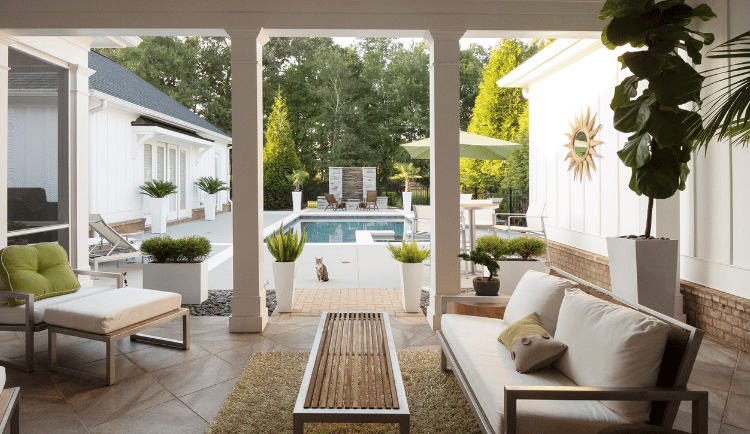
A loggia has no door.
It cannot be locked. It cannot fully belong to the house or to the garden because nothing seals it from either. The house opens, and the loggia is what the opening contains.
This refusal to close is not a limitation.
It is the reason the space exists.
A room that cannot be shut must do something other rooms do not. It must remain available through changing weather, shifting light, and different hours of the day without requiring adjustment.
What The Loggia Is For
The usual definitions are incomplete.
A covered terrace. A roofed outdoor room. A porch with columns.
Each describes a feature without describing the purpose.
The loggia exists because Mediterranean life requires a gradual transition between conditions.
In strong southern climates, the distance between interior shade and open garden sun is too abrupt to cross comfortably at certain hours. The body moves from cool stone to direct heat too quickly.
The loggia slows that change.
It gives temperature, light, and air a place to settle before one becomes the other.
This is why the loggia belongs to the architecture rather than to decoration.
It solves a problem of inhabitation.
The broader rhythm of how Mediterranean houses absorb changing conditions appears in The Southern House and the Rhythm of Daily Life, where climate shapes not only rooms but the way they are used.
The Continuity Of The Floor
The most overlooked detail in a well-made loggia is often the floor.
Stone or terracotta laid inside the house continues outward beneath the roof, frequently ending only where the open garden begins. The material remains consistent. The joints continue. Even weathering feels gradual rather than abrupt.
This continuity is not aesthetic.
It determines whether the loggia feels attached to the house or simply added beside it.
When flooring changes sharply between interior tile, exterior stone, and gravel beyond, the eye reads separation. The space breaks into distinct zones.
When the floor carries through uninterrupted, the transition becomes slower.
The room does not stop and restart.
It changes condition gradually.
The body understands this immediately.
A continuous floor suggests a continuous room.
Structure That Feels Like Opening
A loggia is defined by its open side.
That opening depends on what carries the roof above it.
Columns, stone piers, or beams establish the rhythm of the space.
When supports stand too close together, the eye reads structure before openness. The space begins to feel enclosed.
When supports stand too far apart, the roof appears suspended rather than grounded. The space starts to resemble shelter rather than room.
The balance lies somewhere between.
The spacing must feel wide enough to open toward the garden but close enough to retain enclosure.
This is not a measured formula.
It is a proportion the body recognises.
When the relationship is right, the loggia no longer reads as a covered exterior.
It becomes a room with one side missing.
Depth And The Position Of The Threshold
Depth changes how a loggia can be used.
A shallow loggia functions mainly as passage.
A deeper one allows pause.
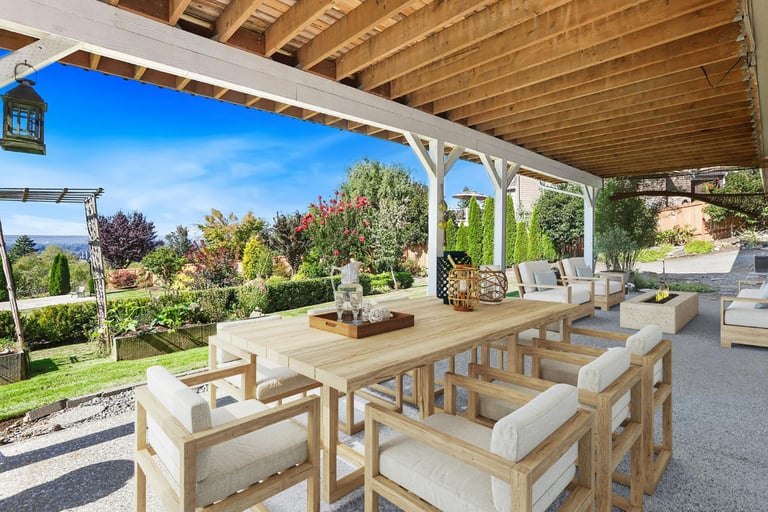
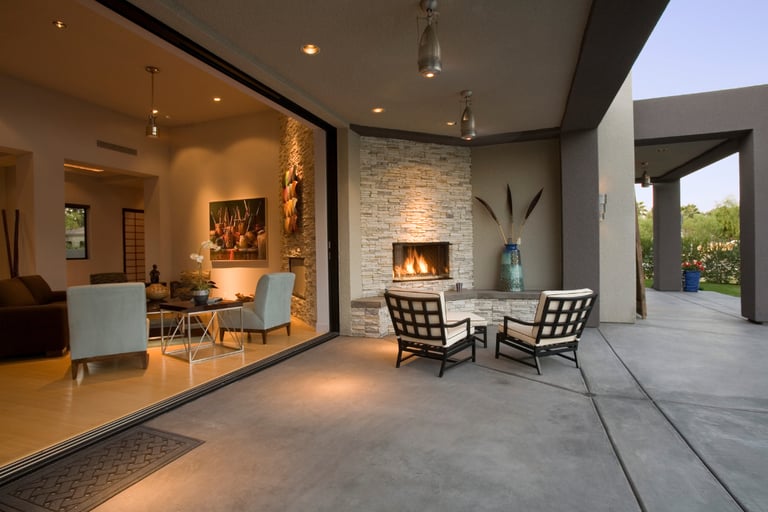
At a certain depth, the space begins to hold furniture, conversation, meals, and stillness without losing its connection to the exterior.
Too narrow, and the body continues moving through.
Too deep, and the space begins to detach from the garden, behaving more like an interior that has lost a wall.
Many older Mediterranean loggias settle around a depth that allows both occupation and openness.
Not a rule.
An observation repeated often enough to feel deliberate.
The threshold between passage and room usually appears when the loggia becomes deep enough to support stillness.
The Hours It Absorbs
The loggia receives the hours that neither the house nor the garden can comfortably hold.
Late morning, when the interior remains cool but the exterior is already bright.
Mid-afternoon, when the garden becomes too exposed and the interior feels withdrawn.
Early evening, when the heat begins to leave the air but the house still holds the temperature of the day.
These are the hours the loggia absorbs.
A meal stretches longer. A chair remains occupied. A conversation continues without requiring movement inside.
Because the space remains usable across shifting conditions, it often becomes one of the most inhabited areas of the house.
Its surfaces record this.
Stone wears slightly where chairs return to the same place. Columns darken where hands pass repeatedly. Thresholds soften under repetition.
This capacity for use depends on materials capable of receiving it. The surfaces most able to absorb contact without losing character appear throughout Materials for Work: Stone, Wood, and Lime.
What It Changes In The Rooms Behind It
The loggia is not only itself.
It changes the rooms that open onto it.
A kitchen or salon positioned behind a deep loggia receives filtered light rather than direct exposure. Sun reaches the interior after reflecting across the floor and passing through shade.
The result is brightness without glare.
Heat arrives more slowly.
Rooms remain cooler because the transition has already happened outside.
This is one reason Mediterranean kitchens often feel connected to outdoor life without becoming exposed to it directly. The placement of these transitional spaces helps define the kitchen as a room integrated into the house rather than separated from it.
Sound behaves similarly.
Voices carried from the garden soften before entering the interior. The acoustic shift between open exterior and enclosed room becomes gradual rather than abrupt.
The loggia performs this work quietly.
Its influence is often felt before it is noticed.
A Room Without A Category
The loggia resists easy naming.
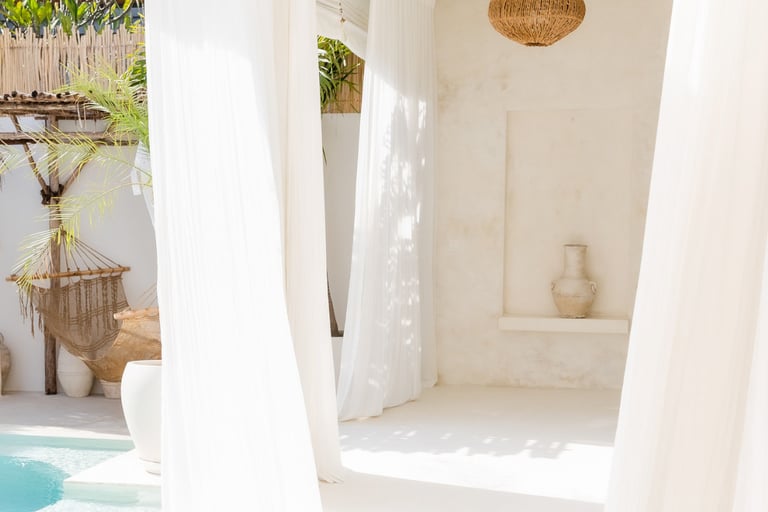
It is neither fully interior nor fully exterior.
The body moving through it experiences neither enclosure nor exposure, but something held between the two.
This is what gives the loggia its permanence within Mediterranean life.
This is why the loggia often becomes one of the most necessary spaces in the Mediterranean house.
Not because it performs a specific task.
But because it holds the hours that do not belong fully anywhere else.
Without it, the day has nowhere to pause.
Contact
© 2025. All rights reserved.
An editorial study of French Mediterranean interiors, shaped by observation, lived experience, and a respect for spaces that age gracefully.