
Daily Rhythm in a French Mediterranean House
Mediterranean houses follow the day, not the calendar. Midday, the long table, evening — habits leave marks on architecture before style ever does.
JOURNAL
How habits became architecture
The Mediterranean house was not designed for photographs. It was not designed to impress visitors or to demonstrate the taste of its owner. It was shaped by a set of daily habits that the climate made unavoidable, and those habits, repeated over time, left marks in the walls.
To understand why these houses feel the way they do, it helps to understand what they were built to withstand.
The midday problem
In much of southern France and the Mediterranean basin, the middle hours of a summer day are difficult to inhabit. By late morning, the sun is direct and sustained. By early afternoon, the heat settles into walls and ground surfaces. Movement slows.
You close shutters not for atmosphere but because the light entering the room begins to carry heat with it. A chair near the window becomes uncomfortable to sit in. The table is moved slightly away from direct sun. The house begins to contract.
Interior rooms hold the coolness of the night. The stone floor remains bearable under bare feet. Walls that seemed thick in winter now make sense.
These are not aesthetic choices. They are responses.
What appears as restraint in these interiors is often the result of necessity: fewer openings, deeper reveals, heavier materials. The house reduces exposure so that it can remain usable.
The long table
By late afternoon, activity returns.
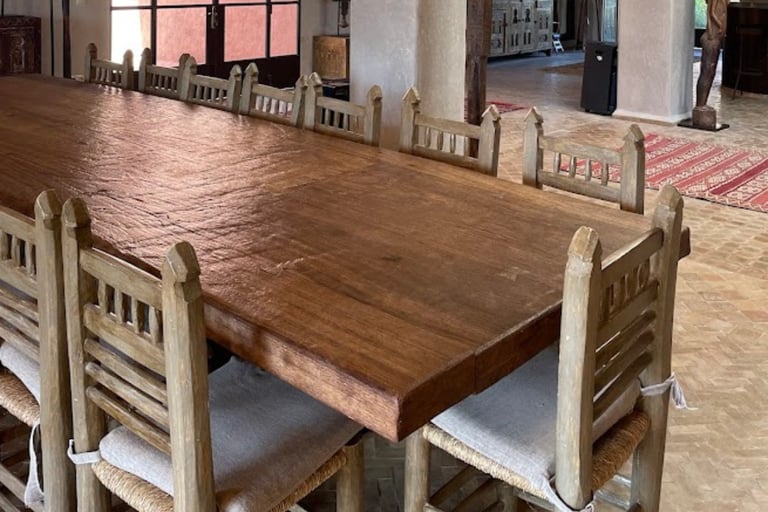
In many southern houses, the main room is organised around a table that sits at the centre, not pushed against a wall, not confined to a separate dining room. Chairs can be drawn from all sides. People pass around it, sit briefly, stand again, return.
A meal may last two hours, or it may last ten minutes. The table accommodates both without needing to be reset or rearranged.
This central position has consequences for the room. Circulation moves around the table, not through it. Other furniture remains secondary. The room is structured by use rather than by display.
The table is not placed to be seen. It is placed to be used repeatedly.
This is one of the reasons these houses tend to feel easy to inhabit over time: the main elements are positioned for routine rather than for composition, a role explored more closely in The Kitchen Table as the Center of the House.
Shade as structure
The exterior of the house is not uniformly usable throughout the day. Full sun in early afternoon can make a terrace difficult to occupy. The interior, at that hour, can feel too enclosed.
Between the two, another space appears.
A shaded terrace, a loggia, a covered outdoor room. Step into it and the change is immediate. The light softens. The temperature drops slightly. Air continues to move.
You are still outside, but not exposed.
This space does not extend the house. It completes it.
Without it, the house would offer only two conditions: interior and full sun. With it, there is a third condition, one that allows the day to continue without interruption.
Evening as a return
As the sun lowers, the house changes again.
Shutters are opened. Windows that remained closed through the afternoon are pushed wide. Air begins to circulate. The heat that settled into the walls starts to release more slowly.
A chair that was avoided at noon becomes comfortable again. The table fills. The house expands back outward.
This moment is gradual. It is not a switch from day to night, but a shift over time. The house allows it because it was built to follow this sequence.
Rooms that felt too bright earlier now receive softer light. Surfaces that appeared flat at midday begin to show depth. The atmosphere changes without intervention.
This gradual expansion often recenters the main living space, where seating, light, and circulation come back into balance — conditions that define the room more than decoration, as explored in the Living Room hub.
Habits that leave marks
Over time, these repeated adjustments shape the house itself.
Shutters are placed where they are needed most. Openings are proportioned to admit light without overheating the room. Materials are chosen because they tolerate this cycle of heat and release.
Nothing is arbitrary. Each element corresponds to a condition that occurs daily.
What is often described as a “style” is, in reality, the visible result of these repeated decisions.
The house becomes legible because it responds to something consistent.
These marks accumulate around use rather than display, particularly in rooms shaped by routine — a condition developed in The French Mediterranean Kitchen.
What the house expects
A Mediterranean house does not expect constant occupation of every room at every hour. It anticipates movement.
Morning in one space. Midday withdrawal into another. Late afternoon in a shaded exterior room. Evening gathered around a table. Night in smaller, more contained rooms.
This sequence is not imposed. It is supported.
The house does not need to be reorganised to accommodate the day. It already contains the conditions required for each part of it.
This is why these houses rarely feel excessive. They do not attempt to solve everything in one space. They distribute use across time and place.
That restraint is not minimalism. It is alignment — a principle that underlies many interiors where nothing feels forced.
Climate, habit, and form
Climate sets the constraint. Habit forms the response. Architecture records both.
The midday retreat, the central table, the shaded terrace, the reopening of the house in the evening — none of these are decorative ideas. They are practical answers to recurring conditions.
Over time, those answers become form.
This is why these houses continue to feel appropriate even when the conditions that shaped them are less severe. The habits remain. The logic holds.
Understanding those habits makes the architecture clearer. Without them, the house becomes an image. With them, it becomes something else: a structure that supports the day as it actually unfolds.
Form follows climate before it follows preference. Climate as the First Designer examines this priority in detail.
Contact
© 2025. All rights reserved.
An editorial study of French Mediterranean interiors, shaped by observation, lived experience, and a respect for spaces that age gracefully.