
The Role of the Corridor in a Mediterranean House
Corridors regulate pace and protect rooms. Without them the house accelerates and rest becomes conditional. Why this overlooked space holds calm.
JOURNAL
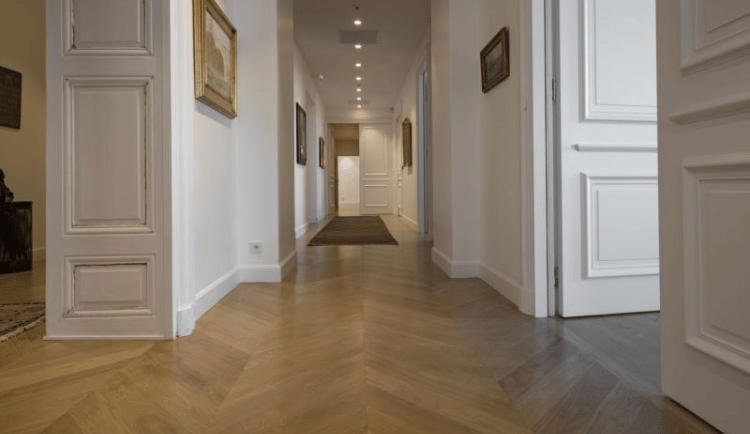
Before it is noticed
In many houses, the corridor is barely registered. It is crossed without comment, often quickly, sometimes impatiently. Yet its presence, or absence, shapes the entire experience of the interior. A house with corridors moves differently. Pace changes. Attention shifts. Rooms are approached rather than entered abruptly. The corridor does not announce itself as a space, but it quietly prepares the next one.
This preparation is subtle. It happens through a few steps taken out of direct view, through light that softens before opening again, through a brief narrowing that reorients the body. The corridor introduces distance without separation. It allows rooms to remain themselves.
A space that regulates pace
Corridors slow movement without stopping it. They interrupt direct lines. You do not move straight from one activity into another. There is a moment of passage. This moment matters more than it appears.
In houses shaped for daily life and long hours of occupation, this regulation prevents overlap. Sound does not travel unchecked. Light does not spill everywhere at once. A bedroom can withdraw even if the living spaces are active. A kitchen can remain functional without dominating the rest of the house. The corridor absorbs transitions that would otherwise collide.
This regulation is physical. It is felt in the number of steps, in the turn of the body, in the brief loss of view. The house gains rhythm without becoming segmented.
Separation without isolation
A corridor creates distance without disconnection. It allows rooms to be close without being exposed to one another. Doors can remain open without collapsing boundaries. Privacy becomes a condition of layout rather than behaviour.
This is particularly important in houses used by several people or occupied over long periods. Daily life does not unfold all at once. Activities overlap. Rest, work, and gathering coexist. The corridor holds these differences without forcing negotiation. It allows retreat without withdrawal and connection without intrusion.
Rather than isolating rooms, it gives them space to exist fully.
Light carried, not dispersed
Corridors handle light differently from rooms. They rarely receive it directly. Instead, they borrow it. Reflected light travels along walls, grazes surfaces, shifts gradually. This softens contrast before the next space opens.
In bright climates, this moderation is essential. Without it, light jumps abruptly from one intensity to another. Rooms feel exposed or flattened. The corridor acts as a buffer. It tempers brightness, protects shadow, and preserves depth. Light arrives prepared, not raw.
This quality is often lost in open plans, where light disperses indiscriminately. Everything is equally lit, and nothing settles.
When corridors disappear
When corridors are removed, the house accelerates. Movement becomes direct. Spaces overlap. Sound travels freely. Light floods without pause. At first, this can feel generous. Over time, it often becomes tiring.
Without transitional space, rooms lose their autonomy. Activities bleed into one another. Rest becomes harder to protect. Calm becomes conditional, dependent on behaviour rather than structure. The house asks its occupants to manage boundaries that the plan no longer provides.
The absence of corridors is rarely felt immediately. It is felt gradually, through fatigue, noise, and the need for constant adjustment. The same shift away from sequence is described in Open Plans and the Loss of Sequence, where the absence of separation produces its own kind of fatigue, and in Thresholds, where doors and steps do quietly what corridors do in length.
How corridors age
Corridors age differently from the rooms they connect. They take wear without registering events. The floor near a doorway darkens before the floor in the centre. The wall near a hand or shoulder picks up the trace of passage. The light that travels along the corridor at certain hours leaves a long, repeated mark on whatever surface it falls on.
These small accumulations are part of why corridors feel grounded in older houses. The space has been used so consistently, in such a similar way, that it has acquired its own quiet record. It is not decorated and rarely renovated, but it carries the daily life of the house more visibly than many of the rooms it serves. To remove the corridor is to remove the part of the house that holds this kind of memory.
Continuity through sequence
Corridors allow the house to be experienced as a sequence rather than a field. One space leads to another, each retaining its character. This sequence creates orientation. You know where you are in relation to the whole.
In houses shaped by climate and daily rhythm, this sequencing is not decorative. It is practical. It allows rooms to respond differently to light, heat, and use while remaining connected. The house becomes legible, not because everything is visible, but because everything has its place.
The corridor does not add space. It gives space meaning. By holding movement, regulating pace, and preparing transitions, it allows the rest of the house to function more calmly. Its role is quiet, but without it, the interior loses depth.
The corridor does not aim to be noticed, but its absence is felt immediately. It belongs to the same family of in-between spaces examined in The Role of Pause: Why Houses Need Moments of Nothing.
Contact
© 2025. All rights reserved.
An editorial study of French Mediterranean interiors, shaped by observation, lived experience, and a respect for spaces that age gracefully.