
How Houses Hold the Evening - Light, Sound, Materials
Evening reshapes a Mediterranean house — first lamp, what contracts, what materials give back. How calm becomes the dominant condition after dark.
JOURNAL


There is a moment in a house when daylight has not quite disappeared, yet artificial light still feels premature.
The directional sun has left the room. Shadows begin to gather along the edges of walls and furniture. Surfaces remain visible but lose their precision. The house enters a condition that belongs neither to afternoon nor fully to evening.
Some interiors move through this hour without resistance. Others become unsettled, as though they do not know what to do once the day begins to withdraw.
The difference rarely comes from lighting alone.
It comes from whether the house was shaped to receive this transition.
The First Lamp
One of the most revealing decisions in a house is which lamp is turned on first.
Not the brightest light. Not the decorative fixture suspended from the ceiling. The first light that appears as the day begins to recede.
In older Mediterranean houses, this first lamp is rarely placed in the formal room. It often appears in the kitchen, beside a chair already occupied, or near the stair where movement begins to slow.
The decision is rarely conscious.
It marks the place where the household begins to gather.
A house in which this first light feels uncertain often lacks an established evening centre. Lamps appear wherever brightness is needed rather than where presence naturally settles.
When architecture has already determined where evening belongs, the first lamp feels inevitable.
It confirms what the room already knows.
What Contracts, And Where
Daylight distributes a household across rooms.
Evening gathers it back.
The parts of the house that felt expansive during the day begin to narrow in use. Certain spaces fall quiet without being closed. Activity concentrates into fewer rooms.
This contraction is rarely deliberate.
The body seeks smaller volumes as light softens and temperatures drop. Conversation moves toward the lit zone. The room nearest to warmth becomes the room that remains occupied.
In many Mediterranean houses, this shift occurs naturally around the kitchen table, where work gives way to lingering presence. The Kitchen Table as the Center of the House explores why this room so often becomes the evening anchor.
A house that supports this movement does not need to reorganise itself after dark.
The evening room already exists.
Its scale, seating, and rhythm were resolved long before the hour arrived.
What The Room Hears
Evening changes the way sound is perceived.
During the day, a house contains a constant layer of background noise: movement outside, air crossing shutters, footsteps between rooms, the small activity of an occupied space. These sounds become ordinary enough to disappear.
As daylight fades, those layers begin to fall away.
What remains becomes more precise.
The settling of timber. The cooling shift of stone. The sound of insects outside that had been present all afternoon but unnoticed.
The room becomes quieter, but not silent.
It becomes more legible.
Thick walls and dense materials heighten this condition. Stone absorbs the noise of daytime activity and allows evening stillness to emerge gradually.
The house no longer masks itself through movement.
Its own quiet becomes audible.
Smaller, Not Brighter
Evening rarely asks for more light.
It asks for less space.
Many interiors respond to fading daylight by increasing brightness evenly across the room. The result often feels unresolved.
The room remains fully visible, but no longer aligned with the hour.
A well-held evening room allows light to gather rather than spread.
The lamp beside a chair. The glow above a table. The small fixture near a work surface.
Beyond these points, the room begins to withdraw.
Corners soften. Ceilings recede. The eye stops reading the entire volume and begins to focus only on the inhabited portion of the space.
The room does not become darker.
It becomes smaller.
The visible area contracts to match the scale of evening.
This relationship between light and occupation appears throughout Light and Rhythm in the French Mediterranean Kitchen, where illumination follows activity rather than overriding it.
What Materials Give Back
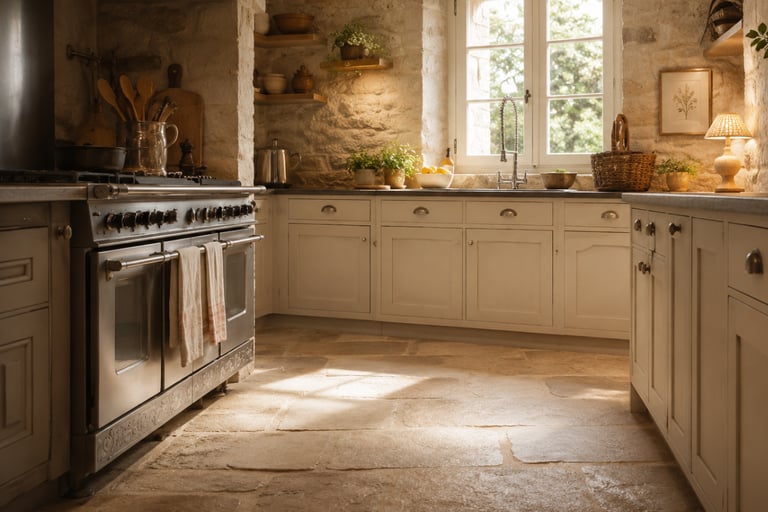
Stone, lime plaster, and oiled wood behave differently at evening than they do at noon.
They begin to return what they absorbed throughout the day.
Stone floors release stored warmth slowly. The shift is slight, but the body notices it. A room with thermal mass feels more settled underfoot as temperatures cool.
Plaster responds differently to artificial light than painted walls. Slight surface variation disperses the glow of a lamp, creating softness without flattening the room.
Wood changes most visibly.
Grain that felt quiet under daylight becomes deeper in side-light. Oiled surfaces darken gently. The material appears less flat and more inhabited.
At this hour, materials stop behaving as neutral surfaces.
They begin to participate in the atmosphere of the room.
What Disappears
The evening room is also defined by what is no longer visible.
A kitchen that worked throughout the day becomes quieter once surfaces are cleared. Objects return to storage. Tools disappear from counters. The room no longer performs its daytime role.
This is not ritual.
It is transition.
The room releases its working identity and becomes available for another use.
Storage matters here not because it organises, but because it allows the room to change state.
A surface that cannot clear itself continues to carry the unfinished presence of work.
This idea appears clearly in Storage as Background in the Kitchen, where containment allows the room to settle once activity has ended.
The architecture remains the same.
Its purpose changes with the hour.
The Test
The simplest test of an evening room is whether anyone wishes to remain in it.
Not whether it is beautiful.
Not whether it photographs well.
Whether the body, once seated, feels any urgency to leave.
Rooms that fail this test rarely do so dramatically.
The light is too general. The volume too open. Surfaces remain reflective rather than absorbent. The traces of the day are still visible.
Rooms that succeed do so quietly.
People remain where they are. Conversation continues or fades without effort. The lamp does its work.
The house holds the hour.
Evening does not begin when the light is switched on.
It begins when the room is ready to receive it.
Contact
© 2025. All rights reserved.
An editorial study of French Mediterranean interiors, shaped by observation, lived experience, and a respect for spaces that age gracefully.