
What Patina Means in a Well-Made House
Patina is not decoration. It is the slow record of use on materials chosen to hold time — stone, plaster, wood — in a French Mediterranean house.
JOURNAL
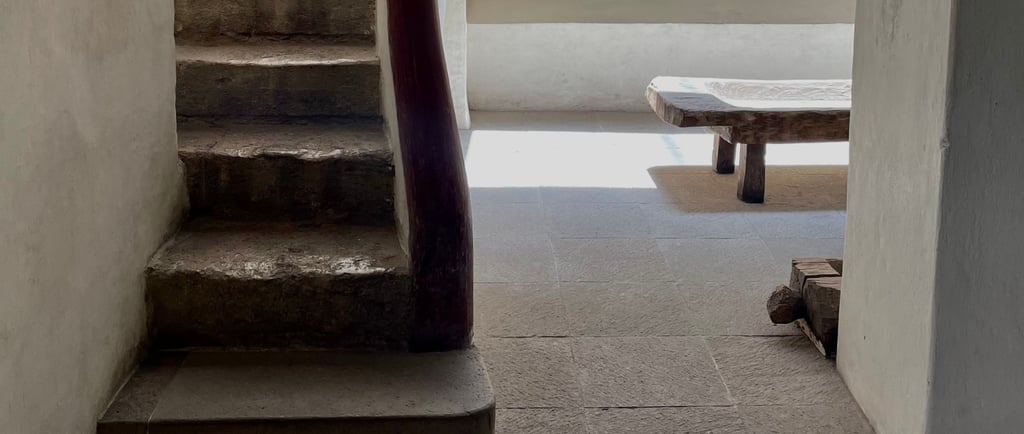
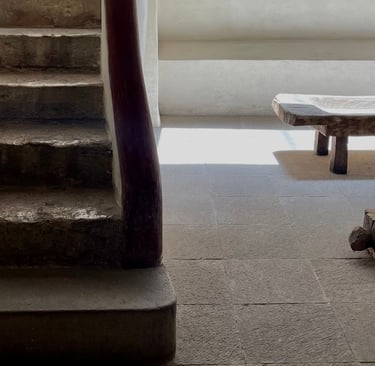
The threshold of an old house is rarely sharp at the centre.
Stone, terracotta, sometimes worn timber: the line is rounded where feet have crossed it for decades, and still crisp at the corners they never reached. The material has not failed. It has registered.
This is the working definition of patina.
Not a finish. Not an aesthetic. The physical record of contact between a surface and a life, held in the material itself.
The Word, Used Correctly
Patina is misused often enough to need restating.
It is not a colour. It is not a treatment. It is not the orange wash applied to new terracotta to suggest age. It is what happens when a material capable of changing is left to receive use over time, without being protected from it.
Stone smooths under repeated contact. Fine irregularities abrade first, then softer mineral veins, until the densest structure becomes slightly more prominent. Lime plaster softens at corners where shoulders pass and around switches touched many times each day. Wood deepens along its grain because softer growth bands compress more quickly than harder ones.
None of this is decoration.
It is the consequence of physical fact, performed at the speed of daily life.
Materials That Can Hold Time
Not every surface is capable of patina.
Some materials remain open to change. Others are built to refuse it.
Limestone, terracotta, lime plaster, oiled wood, unlacquered brass, raw linen, waxed cement: these surfaces remain physically responsive. They can be cleaned, lightly abraded, re-oiled, refinished without replacement. Their character is not fixed at installation. It continues to develop as long as the material remains in use.
Polyurethane-sealed timber, high-gloss paint, vinyl flooring, heavily lacquered surfaces: these are designed to preserve a day-one condition. They do not deepen through use. They either remain visually static or begin to fail.
The distinction matters because the two trajectories feel different over time.
One surface becomes more specific.
The other eventually requires replacement.
This logic appears repeatedly in rooms shaped by use rather than display, particularly where natural materials are selected for how they respond to repetition rather than how they appear when new. Materials for Work: Stone, Wood, and Lime develops this idea through the surfaces most exposed to daily contact.
Use Is The Active Agent
Patina is not produced by ageing alone.
A house left empty for forty years does not develop patina. It accumulates dust. Surfaces oxidise slightly, but they do not acquire the worked quality of a room shaped through repeated occupation.
Patina comes from contact.
Feet, hands, weather, water, light, returning to the same places day after day.
A stone floor in a working kitchen develops differently from the same floor in a guest room rarely entered. One surface is being shaped. The other remains preserved without becoming particular.
This is why patina cannot be convincingly applied.
A wire-brushed plank may imitate age visually, but the marks remain evenly distributed. Real wear concentrates where life concentrates: the threshold most often crossed, the section of counter where objects return repeatedly, the chair edge touched by the same hand each evening.
This relationship between movement and surface becomes more apparent in rooms where work defines the structure of the space, particularly in kitchens shaped around repetition rather than display. Kitchen Work Surfaces as Structure looks more closely at how daily use establishes these patterns.
The specificity is what makes a patinated interior feel inhabited.
The marks do not describe decoration.
They describe behaviour.
What Light Reveals
Patina is rarely visible at noon.
Under flat overhead light, the smoothing of stone reads as uniform. Grain appears quieter. The rounding of a wall edge may seem like a loss of sharpness rather than a quality in itself.
The visibility belongs to side-light.
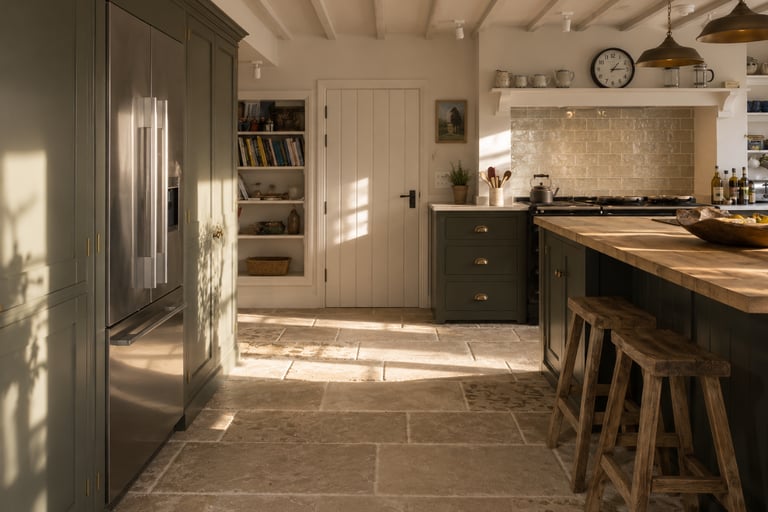
When light enters low and oblique, surface variation becomes legible. Small changes in depth cast shadow. Grain rises slightly from the surface. The worn centre of a step appears darker than its untouched corners.
This is partly why Mediterranean interiors feel different throughout the day.
Light does not simply illuminate a material.
It reveals what time has already done to it.
Walls finished in plaster or lime respond especially well to this shifting light because the surface remains slightly irregular rather than perfectly sealed. How Walls Receive Light explores this relationship between angled light and material depth more directly.
The Economy Of Long Time
Materials that develop patina are rarely the most striking on day one.
Fresh limestone appears honest rather than dramatic. Lime plaster can feel quiet, even plain. Untreated oak often appears lighter and simpler than expected.
The return comes slowly.
At five years, the floor begins to settle.
At twenty, it becomes unrepeatable.
The marks belong to that room, that household, that particular pattern of use. No replacement can reproduce the same accumulation.
This is the inversion understood by the most enduring Mediterranean interiors.
The strongest room is not the one that photographs best when complete.
It is the one that becomes more convincing over time.
The Difference Between Wear And Failure
Patina is sometimes confused with neglect.
The distinction is physical rather than aesthetic.
A patinated surface remains maintained. It is swept, re-oiled, cleaned, occasionally repaired. What is preserved is not perfection but continuity.
A neglected surface behaves differently.
Paint peels. Timber separates. Flooring becomes unstable. The material loses integrity rather than gaining character.
The eye may confuse the two briefly.
The body rarely does.
A floor with patina still feels solid underfoot. A wall with softened edges still holds its shape. The room remains functional even as its surfaces record age.
Patina belongs to materials that continue to perform.
Failure begins when they no longer can.
What The House Holds
Patina is one of the few things a house can produce that cannot be bought, accelerated, or convincingly copied.
It comes from use and time, in that order, and only through materials capable of receiving both.
The rooms that carry the longest meaning are built to accept what life will do to them.
Patina is the evidence that the receiving has taken place.
That evidence becomes the house’s quietest record of itself.
Contact
© 2025. All rights reserved.
An editorial study of French Mediterranean interiors, shaped by observation, lived experience, and a respect for spaces that age gracefully.