
Why Your Terrace Feels Exposed Instead of Relaxing
Most Mediterranean terraces feel exposed rather than restful, not badly designed, just missing an edge, built shade, and a clear sense of use. Learn how to fix that through climate, threshold, material, and zoning, with furniture placed last.
GUIDESOUTDOOR LIVING
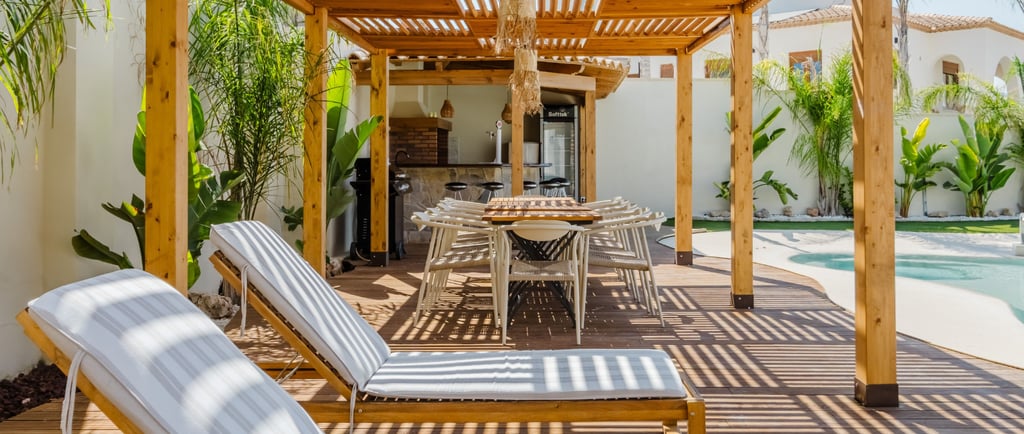
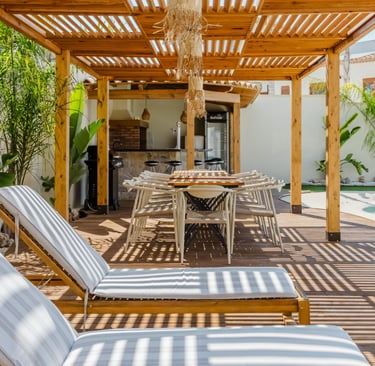
The terrace looks right in photographs.
Stone underfoot. A pergola overhead. A table placed neatly outside the doors. Maybe an olive tree in the corner.
And yet nobody stays out there for long.
This is one of the most common frustrations with outdoor space in the south of France. The terrace is not ugly. The furniture is not necessarily wrong. But after a short time outside, something starts to feel unresolved.
The light is too strong. The floor gives back heat. The wind crosses the table. A neighbour’s window sits in the line of sight. The space looks finished, but the body does not settle.
The problem is rarely style.
It is exposure.
And exposure is not only sun. It is sun, wind, heat, glare, visibility and the absence of a protected edge.
Until those conditions are handled, a terrace remains a place to look at, not a place to use.
Read the Climate
Most terraces are arranged for how they look at midday, not for the hour anyone actually wants to sit outside.
A south-facing terrace without built shade can be unusable through the middle of the day for much of the year. A terrace caught in the path of the mistral can feel uncomfortable even when the temperature is perfect. A west-facing terrace may look calm in the morning and become difficult in the late afternoon.
These problems are often blamed on furniture.
They are not furniture problems.
Before changing anything, stand on the terrace at the hour you actually want to use it.
Not when it photographs best.
When you drink coffee there. When you eat dinner there. When guests arrive. When the children sit outside. When the sun drops low enough to become pleasant or harsh.
Then check three things.
Where is the sun?
Where does the wind cross?
What can see into the space?
The answers matter more than the shape of the table.
Climate as the First Designer carries this logic through the house as a whole. The conditions come first. Arrangement follows.
Create an Edge
A terrace without an edge rarely feels restful.
It may have enough space. It may have a view. It may even have shade. But if the body feels visible from too many sides, it stays slightly alert.
This is why some small terraces feel more comfortable than large ones.
They have a back.
A wall, a hedge, a low screen, a deep planter, a change in level or a planted boundary can do more than decorate the space. It tells the body where the terrace begins and ends.
Privacy is not only about hiding from neighbours.
It is about removing the sense of being on display.
A dining table placed in the open centre of a terrace often feels exposed even if the view is generous. Move it closer to a wall, under a pergola or beside planting, and the same table can feel more settled.
The furniture has not changed.
The edge has.
Build the Shade
Once exposure is felt, the instinct is to buy something portable.
An umbrella. A shade sail. A folding screen.
These can help, but they often behave like temporary answers to permanent conditions. They need to be opened, closed, weighted, cleaned, repaired and replaced. They also tend to sit on top of the terrace rather than becoming part of it.
Mediterranean terraces work better when shade is built into the structure of the space.
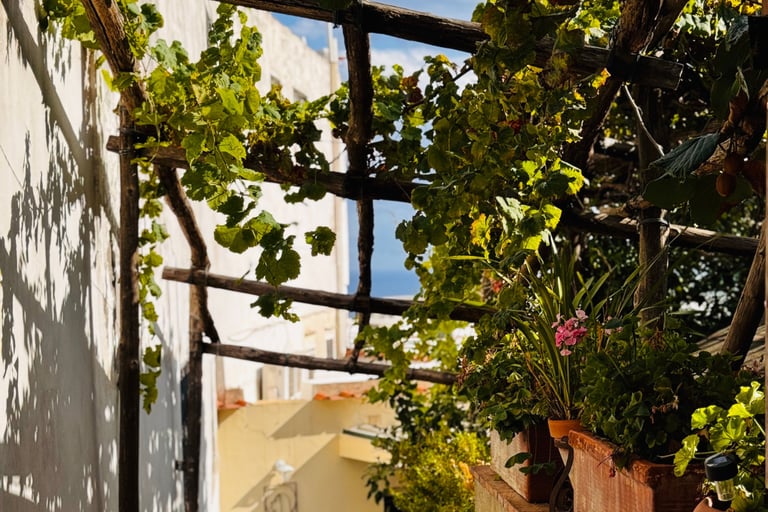
A pergola, a deep awning, a vine, a wall, a tree or a planted frame changes the terrace before furniture arrives.
It also changes the quality of light.
A canvas sail blocks light.
A vine filters it.
A pergola gives it rhythm.
Those differences matter. A terrace does not only need shade. It needs the right kind of shade for the hour it is used.
Light, Shade, and Exposure looks more closely at this relationship between use, sun and built protection.
Watch the Ground
The floor is often the reason a terrace feels harsher than expected.
Pale stone, porcelain tile and glossy outdoor surfaces can look clean in photographs. Under strong sun, they can become difficult to live with. They reflect glare upward. They hold heat at foot level. They make the terrace feel brighter than the sky.
A surface can be technically practical and still wrong for the climate.
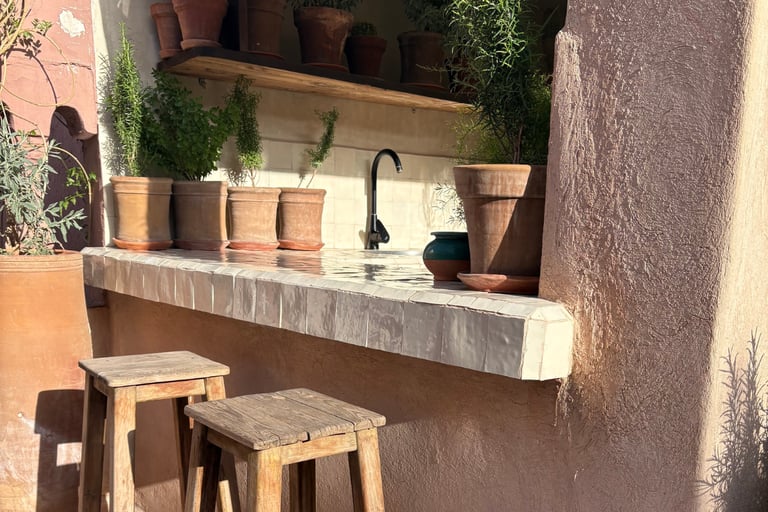
Warm stone, aged terracotta, gravel, limewashed walls and weathered timber behave differently. They do not remove heat, but they soften the way heat and light are held.
This is why material choice outside cannot be treated as a finish.
It is part of comfort.
Choose the grounding material first. Let it set the temperature of the terrace. Then repeat its register in the pergola, planters, wall finish or textiles.
The mistake is adding everything at once.
Stone, metal, plastic, bright cushions, painted pots, a synthetic rug, a new umbrella.
Nothing is strong enough to hold the space.
One material should lead.
The rest should follow.
Make the Threshold Work
A terrace often feels exposed because the transition from the house is too abrupt.
Inside, there is shade, enclosure and control.
Outside, there is sun, wind and visibility.
If the door opens directly from one condition into the other, the terrace can feel more like an open platform than an extension of the house.
A good threshold slows that change.
It might be a deep doorway, a linen curtain moving at the opening, a shaded strip just outside the doors, a bench against the wall, a row of pots, or a slight change in floor texture.
None of this needs to be elaborate.
The point is to give the terrace a first layer before the open space begins.
This is especially important in French Mediterranean homes, where outdoor rooms are often used gradually throughout the day rather than as a separate destination.
The French Mediterranean Terrace and Garden begins with this relationship between house, threshold and outdoor use.
Give It One Job
A terrace trying to be a dining room, a lounge, a sun deck and a photo backdrop usually fails at all of them.
The table is placed for symmetry.
The lounge chairs are placed for a view.
The pots are placed to fill gaps.
Every object may be reasonable on its own, but the terrace has no clear purpose.
Start with the real use.
If dinner happens at eight, the table needs wind protection, filtered light and enough darkness to feel calm as evening arrives.
If coffee happens at ten, the protected morning corner matters more than the largest part of the terrace.
If the terrace is mostly used after swimming, shade and barefoot surfaces matter more than a formal dining arrangement.
One terrace can hold more than one use if it is large enough.
But each use needs its own condition.
The dining area cannot borrow shade from a lounge corner five metres away. A reading chair cannot feel restful if it sits in the visual path of the driveway. A sofa placed in full sun becomes decoration by July.
Every zone needs a reason to exist.
If it does not have one, remove it.
Place Furniture Last
Furniture should be the final decision.
Not because it is unimportant, but because it can only work once the terrace has answered the larger questions.
Where is the shade?
Where is the wind broken?
Where does the body feel protected?
Where does the ground stay comfortable?
Where does the view open without making the space feel exposed?
That is where people will sit.
Usually it is not the centre of the terrace. It is rarely the most symmetrical point. It is the place where climate, edge and use have already been resolved.
Furniture as Extension, Not Feature goes further into choosing outdoor pieces that belong to the terrace rather than pieces that need the terrace to protect them.
Before Buying Anything
Check the terrace in this order.
● Which hour do you actually want to use it?
● Where is the sun at that hour?
● Where does the wind cross?
● What can see into the space?
● Does the terrace have a protected edge?
● Which surface creates the most heat or glare?
● Is the threshold from the house too abrupt?
● Is each zone tied to a real use?
A terrace does not become restful because more things are added to it.
It becomes restful when the pressure is removed.
The sun is filtered. The wind is broken. The eye has somewhere to rest. The ground does not throw heat back at the body. The furniture sits where people naturally want to stay.
That is where a terrace stops being a photograph and starts becoming part of the house.
Contact
© 2025. All rights reserved.
An editorial study of French Mediterranean interiors, shaped by observation, lived experience, and a respect for spaces that age gracefully.