
The Bed as the Only Anchor
Why the bed defines the bedroom before anything else — and how scale, placement, and materials around it decide whether the room ever truly settles.
BEDROOM


The bed defines the bedroom more than any other element.
In a French Mediterranean interior, the bed is not one object among many. It is the point around which the entire room is organised. Scale, circulation, light, and material decisions respond to it.
When the bed is wrong, the room never settles. When it is right, very little else is needed.
Position before design
Placement comes before appearance.
The bed should sit where the room naturally allows rest. Against a solid wall. Away from direct glare. Clear of doors and movement.
Symmetry is secondary. What matters is balance. The bed should feel held by the space, not placed into it.
Once placement is resolved, design decisions become quieter — a relationship that becomes clearer in Light and Proportion in the Bedroom.
Scale that respects the room
The bed must be scaled to the room, not to trends.
Oversized beds compress circulation and dominate the space. Undersized beds feel temporary and unsettled. The correct scale allows the room to remain open around the bed.
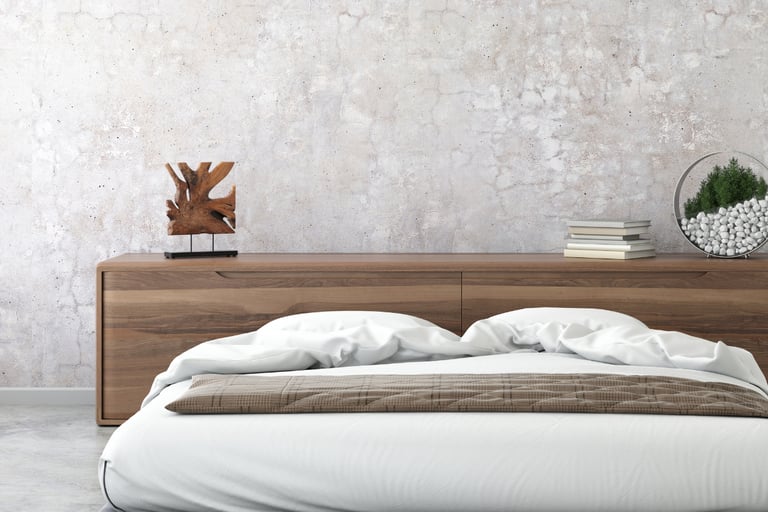
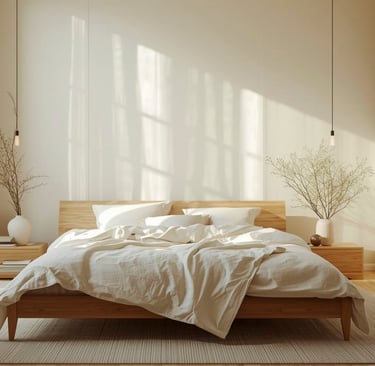
Height matters as much as width. Lower beds maintain sightlines and allow light to move freely. Tall bases or heavy frames interrupt proportion and add unnecessary weight.
Scale is read most clearly from the door. A bed that looks correct from beside it can still overwhelm the room when seen from the entrance — the first vantage point anyone has of the bedroom.
This is why the door view matters. If the bed dominates that view, the room reads as a bed with a room around it, rather than a room with a bed inside it. Reducing the bed by one size, or lowering the headboard, often resolves this without changing anything else.
The bed should feel inevitable, not impressive.
One anchor, not many
The bedroom requires a single point of stability.
When multiple elements compete, the room becomes restless. In a restrained bedroom, the bed carries the visual weight so that everything else can remain secondary.
Night tables support the bed. Lighting responds to it. Storage stays peripheral.
This hierarchy is introduced more broadly in The French Mediterranean Bedroom, where the room is understood through what is left out rather than what is added.
Materials that support stillness
The materials of the bed matter because they remain in constant contact with the body.
Wood frames ground the room and absorb light. Upholstered headboards soften sound and touch. Linen bedding regulates temperature and settles with use.
Highly reflective finishes, sharp edges, or synthetic surfaces introduce tension. They resist both time and attention.
Materials should calm the bed rather than decorate it — an approach developed further in Materials for Rest in the Bedroom.
Space around the bed
The space around the bed is as important as the bed itself.
Clearances should feel generous without becoming excessive. There must be room to move, to pause, to breathe. Tight spacing introduces friction. Too much empty space feels unresolved.
Negative space allows the bed to remain present without dominating.
The same logic applies to circulation. The path around the bed should feel natural in the dark, not just in daylight.
If a person has to step around a corner of the bed to reach the door, or if a night table juts into the walking line, the room never fully relaxes. A bedroom that works well leaves enough clearance to move without thinking — sixty to seventy centimetres on each side at a minimum.
A room that feels crowded often suffers from a misjudged bed scale rather than too many objects.
Minimal accompaniment
Once the bed is correctly placed and scaled, very little else is required.
Two night tables are often sufficient. Lighting remains low and indirect. Additional elements are limited and personal.
If more furniture is introduced, it should respond to the bed rather than compete with it.
The bed sets the tone. Everything else follows.
A room that settles around rest
A successful French Mediterranean bedroom feels organised without effort.
The bed anchors the room quietly. The space around it remains calm. Over time, the room becomes more personal without becoming fuller.
This stillness depends not on addition, but on restraint — a logic developed in The Comfort of Understatement.



Contact
© 2025. All rights reserved.
An editorial study of French Mediterranean interiors, shaped by observation, lived experience, and a respect for spaces that age gracefully.