
Light & Proportion in the Bedroom
Why a Mediterranean bedroom is shaped by softened light and measured scale before anything else. How proportion holds the room steady from morning to night.
BEDROOM


Light and proportion define the bedroom before anything else is considered.
In a French Mediterranean interior, the bedroom is not a place for contrast or visual effect. Light is softened. Scale is measured. The room is shaped to slow the body rather than stimulate it.
If light is harsh or proportions are misjudged, the bedroom never becomes a place of rest, regardless of materials or decoration — a principle introduced in The French Mediterranean Bedroom.
Softened light
Bedroom light should settle, not perform.
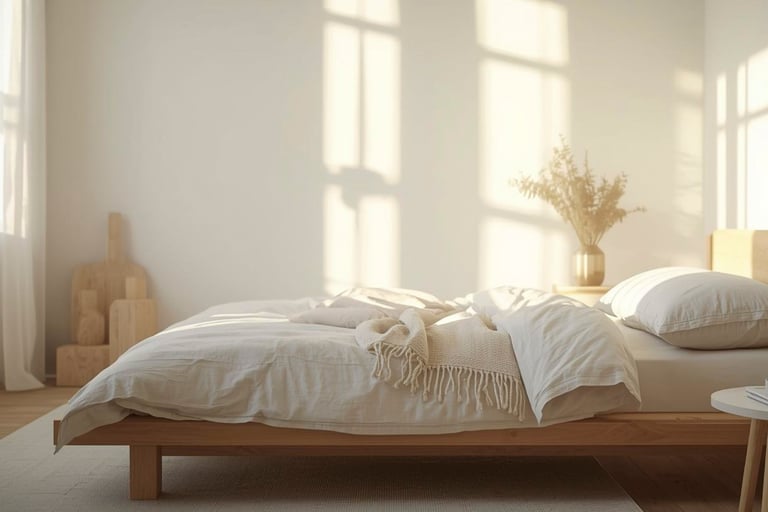
Mediterranean light is often abundant, but abundance does not require intensity. Daylight is filtered through linen curtains, shutters, or recessed openings. The goal is diffusion.
Light moves across walls and floors without sharp edges. Glare, strong shadows, or contrast disrupt the calm the room depends on.
Artificial light follows the same logic. Sources remain low and indirect. Light appears where it is needed and recedes elsewhere.
Scale that allows rest
Proportion in the bedroom is felt immediately.
The size of the bed in relation to the room sets the tone. An oversized bed compresses space and introduces tension. A correctly scaled bed allows the room to remain open.
Clearances matter. Space to move. Space to dress. Space to pause. When circulation becomes tight, the room becomes restless.
A well-proportioned bedroom remains calm even with very little in it.
Light reveals proportion
Light does not conceal proportion. It makes it visible.
Rooms with poor proportions become more uncomfortable as light increases. Rooms that are well balanced become quieter as light softens.
Walls and ceilings should read clearly. Interruptions are limited so light can describe the space without fragmentation.
This clarity prepares the room for materials that absorb rather than reflect, a relationship developed in Materials for Rest in the Bedroom.
Furniture as consequence, not starting point
Furniture does not establish proportion. It responds to it.
In the bedroom, pieces remain low and visually quiet. Nothing rises unnecessarily into the field of vision from the bed.
Night tables align with the mattress. Headboards remain integrated. Storage is contained.
When the bed is treated as the room’s primary anchor, every other element finds its place naturally, a relationship explored in The Bed as the Only Anchor.
Where light enters
Light in a bedroom is shaped by where it enters before it is shaped by how much.
A window placed high on the wall reads differently than one placed low. A shutter angled across the morning sun produces a softer room than a curtain pulled flat. Two openings on adjacent walls produce a more balanced light than one large opening on a single wall, even when the total surface of glass is the same.
In French Mediterranean houses, openings are often modest in scale and carefully placed. Light is allowed in where the body will be — across the bed in the morning, against a sitting wall in the afternoon — and excluded from where it would only create heat or glare.
This is not a question of dimming the room. It is a question of giving light a path that makes sense for rest. A bedroom that gets the position of its windows right rarely needs heavy treatments to feel calm.
Why southern houses are built around filtered light rather than maximum light is developed in Why Southern Homes Prefer Filtered Light.
Consistency over the day
A bedroom should remain stable from morning to night.
Light arrives gradually and recedes without contrast. The room does not shift character as the day passes.
This consistency allows rest to happen without adjustment. The space supports rather than reacts.
When light and proportion are resolved early, everything that follows becomes quieter, including color — a progression developed in Color in the Bedroom.


Contact
© 2025. All rights reserved.
An editorial study of French Mediterranean interiors, shaped by observation, lived experience, and a respect for spaces that age gracefully.