
What Makes a French Mediterranean Home Feel Calm
A French Mediterranean home feels calm because of how it handles light, proportion, material and daily use, not because of decoration. Calm is the result of structure, not styling.
GUIDES
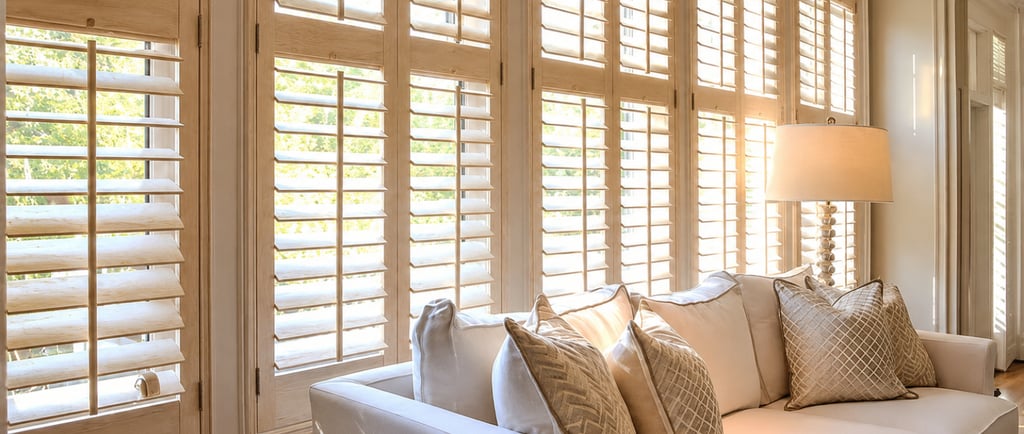
Many homes are decorated to look Mediterranean. Fewer are arranged to feel Mediterranean.
The difference has nothing to do with budget, and very little to do with the materials list pinned above a desk. It comes down to the order in which decisions get made.
A calm French Mediterranean home is not the result of a mood board, or a single well-chosen sofa, or even good taste applied generously. It is the result of four decisions, made in a fixed order. Light comes first. Proportion comes second. Material comes third. Use comes fourth. Color comes last, because color is what those four decisions produce. It is not what causes them.
Reverse that order, and a room can have every element associated with the style and still feel wrong. Keep the order, and a plain room with almost nothing in it can feel more settled than one filled with the right objects placed in the wrong sequence.
None of this is a matter of taste. Light, proportion, material, and use can each be checked against the room itself rather than against a reference image. A room either has somewhere for its light to land or it does not. Furniture either has space to be read individually or it does not. That is what makes the order useful: it gives a way to diagnose a room that feels wrong, rather than simply reshopping it.
This is the structure behind the feeling people are usually trying to describe when they say a house feels like the south of France. Every room article on this site returns to this order in one form or another.
Light Comes First
Light is the first decision because it changes how every later decision reads. A wall does not have one color. It has as many versions of that color as it has hours of light crossing it through the day.
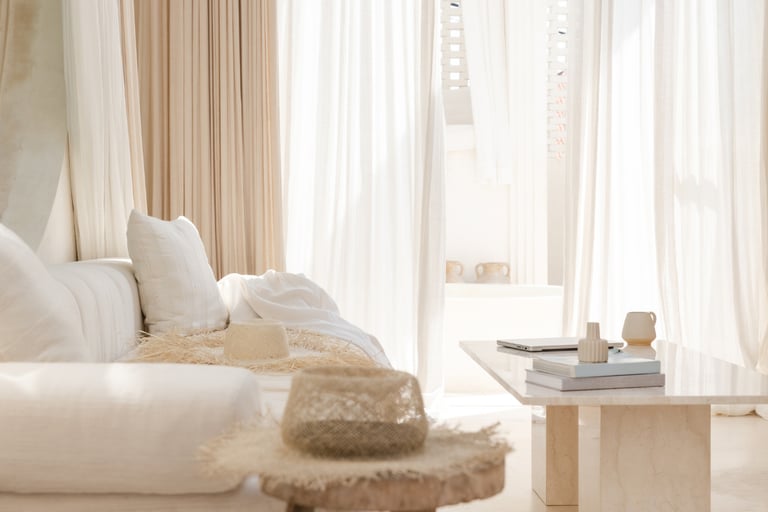
In the south of France, the usual problem is not too little light. It is light with no resistance: flat, direct, and unbroken from early morning until evening. A room can be technically bright and still feel hostile, because nothing inside it is slowing the light down before it lands.
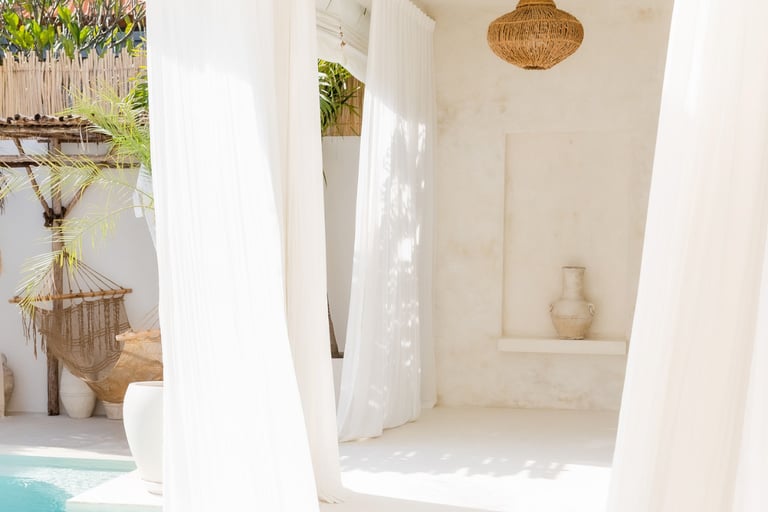
A room with shutters half-closed at midday often feels calmer than the same room with its white walls left fully exposed to a clear sky. The amount of light has barely changed. What has changed is that the light now has somewhere to land before it spreads across every surface at once.
This is why the usual instinct, heavier curtains, a flatter white paint, rarely solves the problem on its own. It treats light as something to block rather than something to shape. The interiors that feel calm are not the darkest ones in the village. They are the ones where light has been filtered, angled, or interrupted before it reaches a surface with nothing to absorb it.
The same room rarely needs the same treatment all day. A kitchen facing east takes a different kind of light at breakfast than it does by mid-afternoon, and a living room facing south behaves differently in August than it does in February. Shutters, awnings, and the placement of taller planting outside a window are not decoration. They are a way of adjusting how much resistance a room gets at the hour it is actually used.
Once the sun goes down, the same logic continues under a different name. A single bright overhead bulb is the evening equivalent of a wall with no shutters: technically sufficient, and still hostile. Lower, warmer, indirect light in the evening is filtering the room in the same way shutters filter it at noon. The fixture changes. The principle does not.
Shutters and heavy curtains were never purely a light decision in this part of the world. They also keep heat out during the hottest hours and keep a room from being visible from the street, and a house that handles light well is usually handling temperature and privacy at the same time, with the same gesture. Treat them as three separate problems, and the room gets three competing fixes. Handle them together, and the room simply works.
That is the entire argument behind How to Soften a Bright Room Without Making It Dark: the fix for a harsh room is almost never less light. It is light given more resistance on its way in.
Proportion Sets the Room
Once light has been accounted for, proportion decides whether a room can hold what is placed inside it. This has little to do with minimalism. A room with very little furniture in it can still feel cramped, if that furniture is the wrong size for the space around it.
A large sofa pushed into a narrow room does not become calmer because it is upholstered in linen instead of velvet. The fabric is correct. The proportion underneath it is not, and no material decision made afterward corrects a scale mistake made first.
Proportion is also why empty space gets misread so often. An uncluttered corner is not a stylistic restraint, a gap left for the sake of looking austere. It is what allows the eye, and eventually the body, to register where one piece of furniture ends and the next one begins. Remove that gap, and even well-chosen pieces start to compete with each other rather than sit together.
Ceiling height changes what proportion even means in a given room. A low-ceilinged room can carry a large piece of furniture if the rest of the room is kept simple, while the same piece in a tall, narrow room can make the walls feel like they are closing in rather than rising. Proportion is read between objects and the room's own shape, not from a furniture catalogue measured against floor space alone.
The same logic applies to what a room frames, not only what sits inside it. A doorway left clear of furniture, or a window with nothing placed directly in front of it, lets the eye travel through the room rather than stopping at the first obstacle. A house with good proportion has views through it, not just objects within it.
Proportion also governs how a room is actually walked through, not only how it looks from one fixed seat. A clear path from the kitchen to the terrace door, wide enough to carry a tray without sidestepping a chair, does more for how a house feels day to day than a perfectly styled vignette nobody walks past. A floor plan that respects how people actually move tends to age better than one arranged purely for a single photograph taken from the doorway.
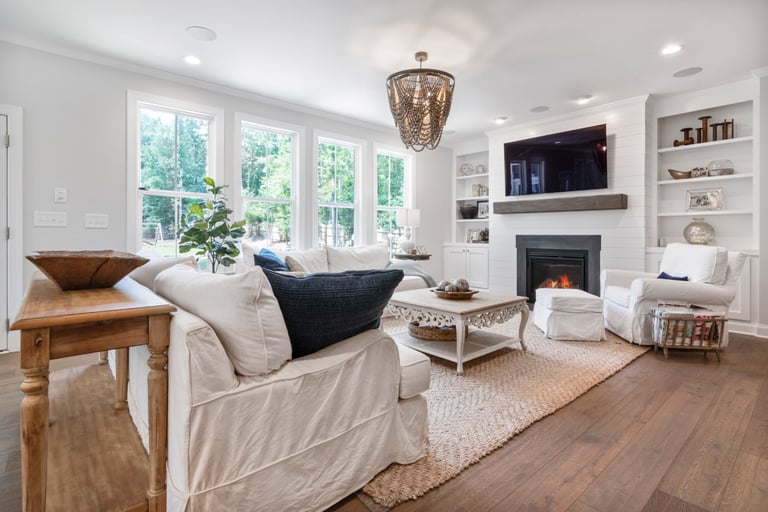
This is the logic that runs through The French Mediterranean Living Room: a room reads as calm once its furniture has enough room around it to be read individually, rather than as one undifferentiated mass against the walls.
Materials That Age
Material is the third decision, and the one most often mistaken for the whole philosophy. French Mediterranean interiors are not defined by limestone, plaster, terracotta, or raw wood as a checklist. They are defined by a habit of choosing materials for what they will do after ten years, not for how they look on the day they are installed.
A glossy surface looks its best on that first day and slightly worse every year after. A natural surface, limewash, raw stone, untreated wood, tends to do the opposite. Marks, fading, and the small unevenness that comes with use read as evidence the house is being lived in correctly, rather than as damage waiting to be corrected.
This is also where interiors that intend to feel calm most often go wrong. Natural materials are not automatically calm simply because they are natural. A room that combines oak, rattan, travertine, terracotta, linen, brass, and limewash in equal measure does not read as grounded. It reads as a showroom that lost its nerve. Calm comes from repetition, not from variety. One or two materials, repeated consistently across a room, carry more weight than five different ones used once each.
The same principle applies below the surface, not only on it. Reclaimed stone set beside new tile rarely looks intentional unless something else in the room repeats the texture or tone of the older material. Old and new can sit together, but only if one of them is doing the work of bridging the two, rather than leaving them to compete as separate eras in the same room.
Soft materials age in their own way, and the same patience applies to them. Linen that has been washed for years softens and loses its sheen rather than its usefulness, and a rug that has taken years of foot traffic settles into the floor in a way a new one cannot fake. Treating fabric and stone by the same rule, judging them on how they will look in a decade rather than tomorrow, keeps the whole room consistent.
None of this requires the most expensive version of a material. A modest limewash applied with care will age better than an expensive engineered surface chosen because it photographs well on day one. The budget question is not how much a material costs. It is whether the same one or two materials are used with enough consistency that the room reads as a single decision rather than several unrelated ones.
Mediterranean Bathroom Materials That Age Well looks at this question in the room where the wrong choice shows up fastest, since no surface in a house takes daily contact, water, and heat the way a bathroom does.
Use Shapes the House
The fourth decision is the one most often skipped, because it cannot be photographed. Use is what happens to a house once people actually live in it: where a door gets left open through the afternoon, where a chair takes daily contact, where a surface absorbs the wear of hands, bare feet, and bags set down without thinking.
A terrace door that gets opened every morning shapes how a house feels more than a chair placed somewhere nobody ever sits. A house arranged for how it photographs and a house arranged for how it is actually used can contain the exact same objects and still not be the same house.
The kitchen is usually where this gap is widest. In many French Mediterranean homes it functions as the real living room, the place where people actually gather, while a separate formal living room stays photogenic and largely unused. A kitchen built around how a family actually moves through it will feel calmer than one arranged purely for how it looks from the doorway.
Use also shifts with the season in a way that style decisions rarely account for. A terrace that holds breakfast in May and shade in August is doing two different jobs with the same furniture, and a house that flexes between them, opening up in summer and closing in for winter, tends to feel more settled across the year than one fixed permanently in a single arrangement.
The French Mediterranean home is rarely only indoor or only outdoor. Its calm often sits in the space between the two: a covered terrace, a shaded threshold, a door left open through the warm part of the day. These transitions are not a decorative flourish borrowed from a brochure. They are a practical response to a climate that makes a fixed boundary between inside and outside impractical for most of the year.
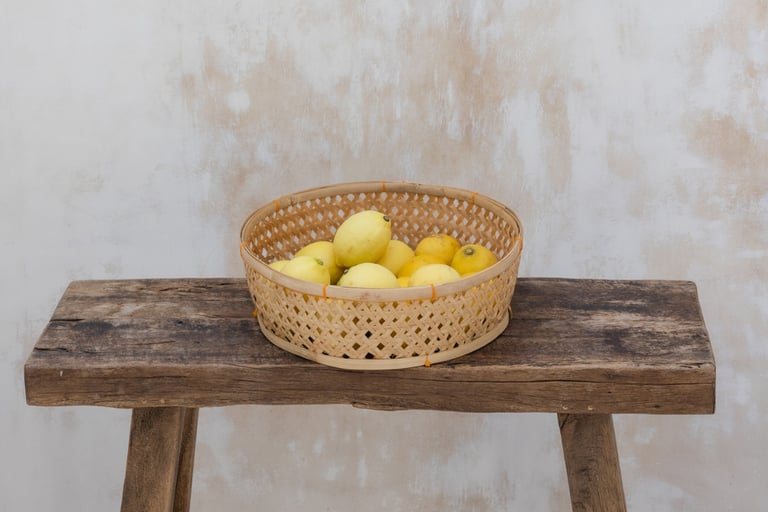
How a house handles the ordinary clutter of daily life is part of the same question. Keys, shoes, post, the basket that holds whatever was carried in from the car, all need a place that is not the dining table. A house with no real answer for where these things go will look disordered no matter how carefully the rest of it was arranged, because the objects of daily use will simply find their own spot, usually the one that looks worst.
One version of this threshold, a space that belongs fully to neither the house nor the garden and is calmer for it, is covered in The Loggia and the Space That Belongs to Both Worlds.
Color Comes Last
By the time light, proportion, material, and use have already been decided, color has very little left to do. It is not a neutral choice made independently of everything else in the room. It is the visible result of light, proportion, material, and use already decided.
This is why blue and white is such an unreliable shortcut to the style. Blue and white can belong in a Mediterranean room. They do not create one. Without filtered light, balanced proportion, and grounded material underneath them, they become costume: a reference to the look, borrowed without the structure that made the look feel inevitable in the first place.
Color also behaves differently under this light than it does on a paint chip indoors. A pale tile that looks almost white in a showroom can read warm or even slightly pink once it sits under direct southern sun, and the same off-white can look cool and clinical in a north-facing room that never gets that sun at all. Choosing color before testing it in the actual room, at the actual hour it will be seen, is choosing it blind.
The houses that feel most calm are rarely the most colorful. They are the ones where color was the last decision made, arriving after the room had already been resolved by everything that came before it. A pale wall in a well-proportioned room with the right materials reads as settled. The same pale wall is the first thing anyone notices in a room that has not yet been resolved.
Most natural materials in this region lean warm rather than cool: limestone, terracotta, raw plaster, aged brass. A paint or fabric chosen with a cool undertone tends to sit against them rather than with them, even when the colors are technically close on a swatch. Matching the undertone of a new color to the materials already in the room does more for calm than matching its hue alone.
Light, then proportion, then material, then use. Color, last, because it follows from everything that came before it rather than leading it.
That is the order behind every room described on this site, whatever the room, whatever the season outside it. A calm house is not a finished look achieved once and maintained. It is a house that no longer needs to explain itself.
Most of the fixes worth making in a French Mediterranean home come from going back to whichever of these four was skipped, not from adding something new. A room rarely needs another object. It usually needs its light, its proportion, its material, or its use looked at honestly, in that order, before anything else changes.
Contact
© 2025. All rights reserved.
An editorial study of French Mediterranean interiors, shaped by observation, lived experience, and a respect for spaces that age gracefully.