
Color in the French Mediterranean Bedroom
How color holds a Mediterranean bedroom together quietly — light first, material second, palette last. Why restraint allows the room to read the same all day.
BEDROOM
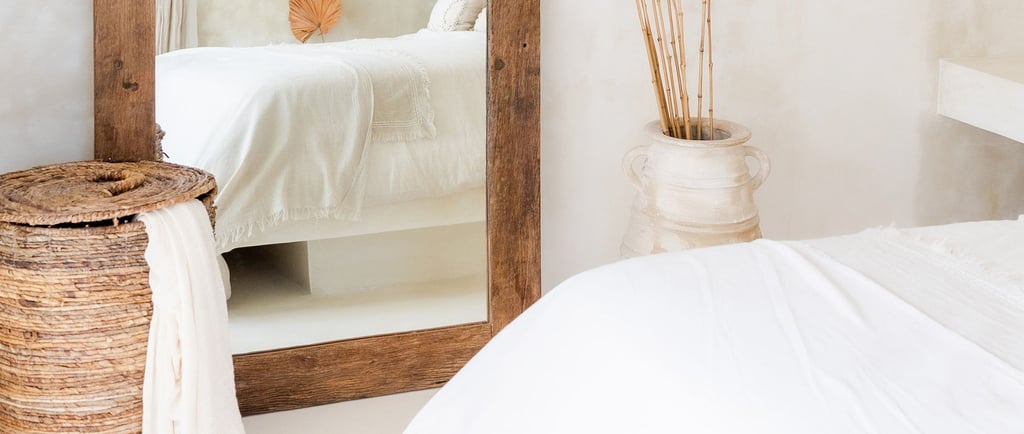
Color in a French Mediterranean bedroom does not lead.
It supports what has already been established by light, proportion, and material. Its role is to hold the room together quietly, not to define a mood or announce a style.
When color is asked to do too much, the bedroom becomes restless. When it is restrained, the room settles.
Color follows light
Light determines color, not the other way around.
Mediterranean light shifts throughout the day, warming in the morning and softening in the evening. Colors that belong in the bedroom must remain stable through these changes rather than reacting to them.
Washed whites, warm stone, and muted earth tones absorb light gently. They remain consistent as light moves, allowing the room to feel continuous.
Brighter whites, strong contrasts, or cooler tones tend to become harsher as the day fades — a behavior explained more precisely in Light and Proportion in the Bedroom.
A narrow palette
The bedroom benefits from limitation.
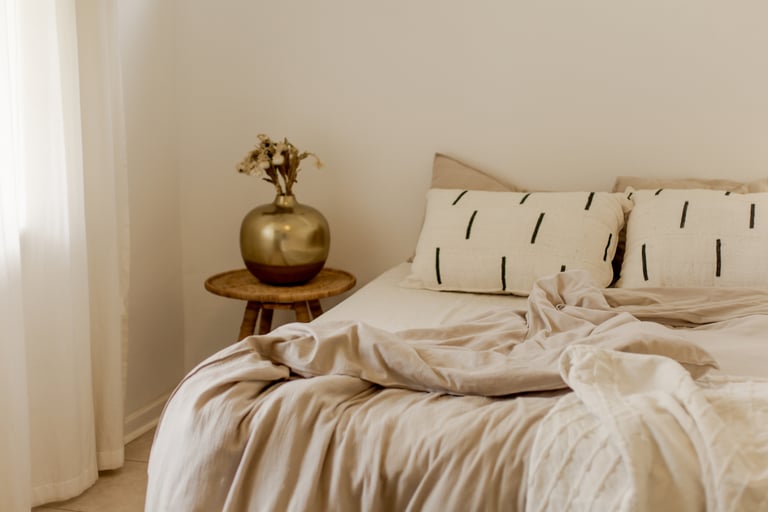
One base tone, supported by one or two secondary shades, is usually sufficient. Variation comes from material and texture rather than hue.
Walls, bedding, and larger surfaces remain closely related. Strong contrast fragments the room and introduces unnecessary movement.
A restrained palette allows the eye to move slowly and without interruption.
The reason these tones do not need to perform is examined in The Difference Between Natural and Neutral.
Materials carry the color
Color in the bedroom is rarely applied. It is carried by materials.
Linen introduces softened whites and natural variation. Wood brings warmth through grain. Plaster creates subtle tonal shifts that cannot be replicated by paint.
These materials build depth without relying on saturation.
When materials are chosen correctly, additional color becomes unnecessary — a relationship developed in Materials for Rest in the Bedroom.
The bed sets the tone
Color decisions respond to the bed.
Bedding, headboards, and surrounding surfaces should sit naturally together. If the bed feels too heavy, the room tightens. If it disappears completely, the room loses structure.
Subtle tonal differences work best. They define the bed without isolating it.
The bed anchors the palette quietly, allowing everything else to remain secondary, as explored in The Bed as the Only Anchor.
Avoiding emphasis
Bedrooms are not the place for emphasis.
Bold colors, sharp contrasts, or decorative patterns introduce energy that works against rest. Even in small amounts, they tend to draw attention back into the room.
If emphasis is needed, it comes from texture or material density, not color.
The room should remain coherent even in low light.
Color in low light
Bedrooms operate in low light more than any other room.
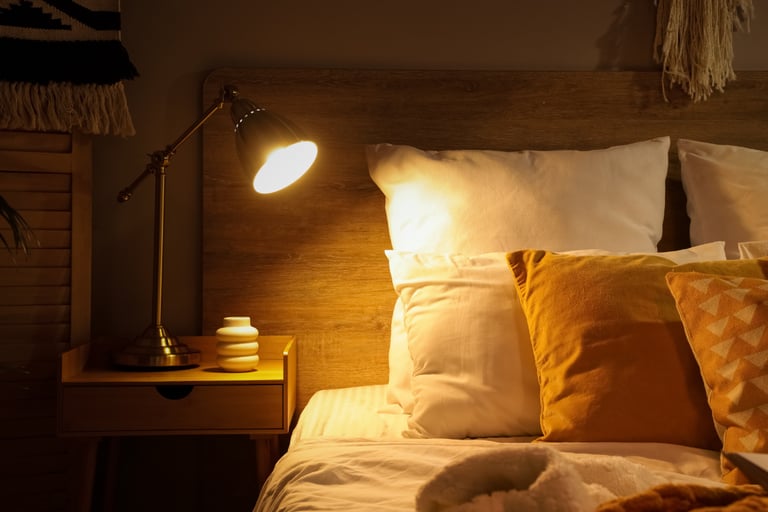
Early morning before the shutters open, evening after a single lamp comes on, the long stretches of darkness in between — the bedroom is read in dim light for most of the hours it is used. A palette chosen under midday sun rarely behaves the same way at these hours.
Tones that hold in low light tend to share a quiet warmth. Washed whites with a touch of stone in them. Soft clay. Muted greens that read as grey when the room is dim. These colors do not collapse into a single flat tone after dark — they keep their depth without sharpening.
Cool whites, strong blues, and high-contrast palettes do the opposite. They look crisp at noon and feel hard by evening. The room can no longer be lived in the same way as the light fades.
A bedroom palette is tested at night more than at noon. If it still feels like the same room when only one lamp is on, the colors are right.
A room that holds together
A well-resolved bedroom palette feels continuous.
Morning and evening read the same. Artificial light does not distort the space. Nothing becomes louder at night than it was during the day.
Color supports the room rather than defining it. It allows light, proportion, and material to remain legible — a logic introduced in The French Mediterranean Bedroom.


Contact
© 2025. All rights reserved.
An editorial study of French Mediterranean interiors, shaped by observation, lived experience, and a respect for spaces that age gracefully.