
The Kitchen as a Continuous Surface
Why a French Mediterranean kitchen is built as one system, not as separate surfaces, materials, storage and color. The logic that keeps the room stable.
KITCHEN
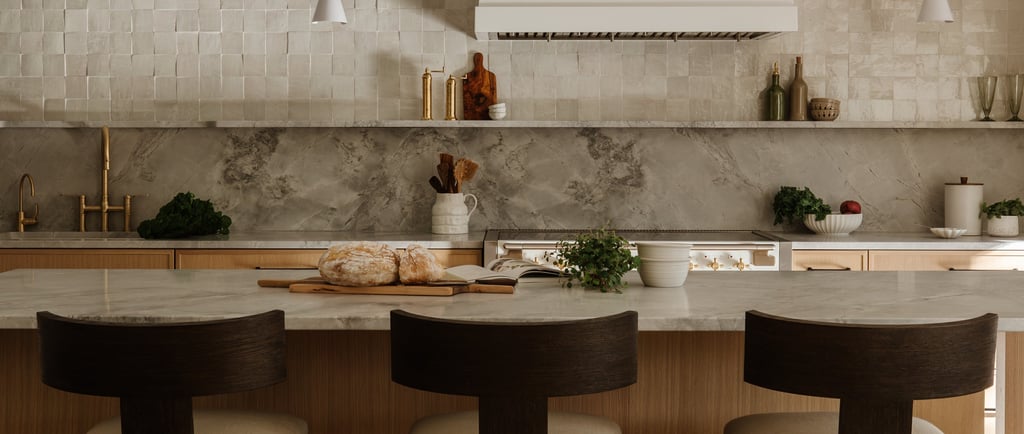
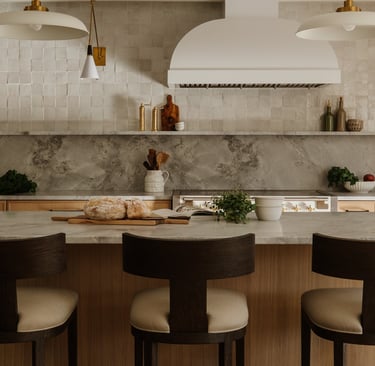
The kitchen is not made of separate decisions.
It is not surfaces, then materials, then storage, then color.
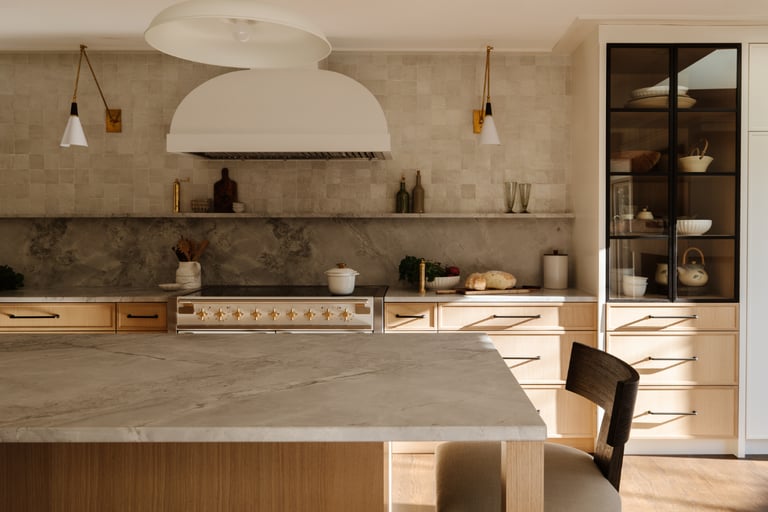
It is a single system, where each element depends on the others from the beginning.
In a French Mediterranean kitchen, this system is built around use. Surfaces define movement. Materials determine how those surfaces behave. Light reveals whether the system holds together.
When these decisions are made separately, the kitchen fragments. When they are resolved together, the room becomes clear and stable — a condition introduced in The French Mediterranean Kitchen.
Surfaces as the base layer
Everything begins with the surface.
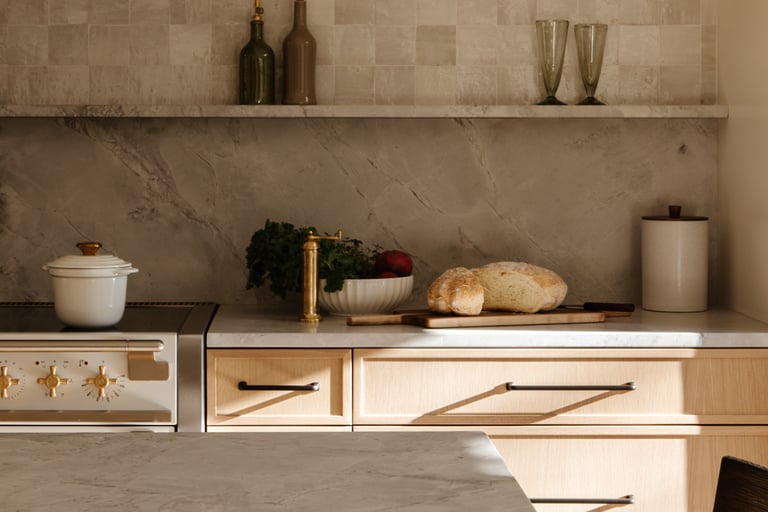
Before cabinets or appliances, the question is where work happens. Preparation, washing, placing, returning. These actions repeat constantly, and the surfaces that support them must remain continuous.
When surfaces are fragmented, movement slows. When they are clear, work becomes instinctive.
This is why the kitchen is structured from the counter outward, not the furniture inward — a logic established in Kitchen Work Surfaces as Structure.
Materials as behavior
Materials are not applied to surfaces.
They define how those surfaces perform over time.
Stone absorbs use. Wood softens contact. Lime regulates light and sound. These materials are not chosen for their appearance but for their ability to remain stable under repetition.
If a material resists change, it creates tension. If it accepts it, the surface becomes easier to use.
This distinction shapes the entire room, as explored in Materials for Work in the Kitchen.
Light as the validator
Light does not decorate the kitchen. It tests it.
Throughout the day, light moves across surfaces, revealing every decision. It exposes glare, imbalance, and material inconsistency. Nothing remains hidden.
A kitchen that works in strong light will continue to work in softer conditions. One that relies on effect quickly breaks down.
This is why light is not an afterthought but part of the structure itself, clarifying how surfaces and materials perform in practice. Light & Rhythm in the Kitchen takes this further from the light side.
Storage within the system
Storage is not added to the kitchen. It is absorbed into it.
When storage is treated as furniture, it competes with the surfaces. When it is treated as part of the wall, it disappears.
Closed fronts, continuous planes, and controlled placement allow storage to support use without interrupting it.
This is what allows the kitchen to remain readable even in constant activity, as shown in Storage as Background in the Kitchen.
Continuity over variation
A kitchen holds together through continuity.
Materials remain consistent. Tones stay close. Transitions are limited. This reduces visual noise and allows the system to function without distraction.
Color does not introduce variation. It follows what is already established by material and light.
When continuity is maintained, the room remains stable even as it is used, a principle clarified in Color in the Kitchen.
One system, not layers
Most kitchens fail because they are assembled in parts.
Surfaces are chosen first. Materials are added later. Storage is fitted in. Color is applied last. Each decision is made in isolation.
The result is a room that requires adjustment and correction.
In a French Mediterranean kitchen, these elements are resolved together. Surfaces, materials, light, and storage form a single structure that supports use without needing to be managed.
This is what allows the kitchen to remain calm under pressure.
A structure that holds over time
A well-resolved kitchen does not improve through redesign. It improves through use.
Surfaces become familiar. Materials develop depth. Movement becomes predictable. The room requires less attention, not more.
This stability reflects a broader pattern found in houses where daily life is supported rather than staged, as explored in The Southern House and the Rhythm of Daily Life.
The kitchen works when nothing needs to be reconsidered.
That is what makes it last.
Contact
© 2025. All rights reserved.
An editorial study of French Mediterranean interiors, shaped by observation, lived experience, and a respect for spaces that age gracefully.